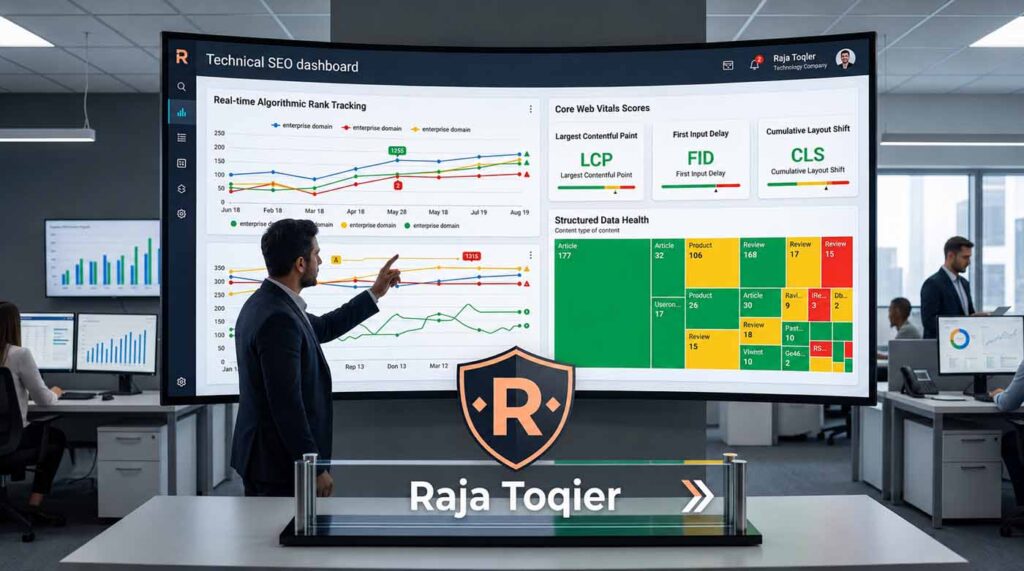
What is an SEO Technology Company?
An SEO technology company is a business that leverages proprietary software, automation and technical engineering not just manual tactics to improve a website’s visibility in search engines and AI-driven answer engines. For a plain-English primer on the fundamentals these companies build on, see our beginner’s guide to technical SEO. These companies typically offer a SaaS SEO platform, developer-level code optimisations, and data-driven reporting to scale organic growth for enterprise and B2B clients.
If you’ve ever compared a traditional marketing agency to a firm that throws around terms like crawl budgets, structured data, and rendering audits, you’ve felt the difference already. One depends on content calendars and link outreach. The other treats search visibility as much an engineering problem as a creative one.
That distinction matters more now than it ever did. Search itself is fragmenting – into blue links, AI Overviews and full conversational answers pulled from large language models. Knowing what these companies do, and how they differ from each other, is the first step to choosing the right partner.
The Two Pillars of SEO Tech: Software vs. Services
There isn’t just one kind of “SEO tech company.” The space generally divides into two camps: the tool builders and the tool users. Some companies build the software. Others use software (often multiple platforms at once) to deliver hands-on results. It’s important to understand this split so you don’t end up purchasing the wrong kind of solution.
1. Enterprise SEO SaaS Platforms
The first pillar is the enterprise SEO software category with companies like Semrush, Ahrefs, and seoClarity. The platforms are built on a custom software suite that automates keyword research, algorithmic rank tracking and automated backlink analysis at massive scale.
They have a lot of power to automate data processing and generate an SEO market report for thousands of keywords at a time. But a platform subscription alone won’t fix a slow website, broken schema, or a JavaScript rendering issue that hides your content from crawlers. These tools are much better at telling you what is wrong than fixing it.
The complex crawl budgets and machine-readable frameworks are often not addressed in DIY setups. If you want a powerful platform that has been engineered specifically for next-generation search engines, then working with an expert SEO agency platform will ensure that your underlying architecture meets the demands of true enterprise engineering.
2. Tech-Driven SEO Agencies
The second pillar is the hybrid developer-SEO team, or an individual, who writes and edits code directly to solve ranking problems. They don’t just talk about technical web code optimisations, they do it: rewriting rendering logic, fixing canonical tags, restructuring internal linking architecture, and deploying structured data at the codebase level.
This is where outsourced search engine optimisation moves from advisory to execution. A tech-savvy agency doesn’t just show you a Core Web Vitals score on a dashboard, they get into the repository and fix it. If you’re assessing vendors, our guide to SEO for tech companies in competitive digital markets shows how this execution-first model plays out in practice.
Ready for hands-on technical execution, not just another dashboard?
Crucial Technical SEO Requirements for Modern Tech Platforms
If you’re building software or a website, some technical basics are non-negotiable in the year 2026. AI Overview crawlers, as well as traditional search bots, reward sites that make their content easy to parse.
- Schema markup: Structured data (JSON-LD) that explicitly tells search engines and AI systems what your content is, not just what it says. This includes the schema types Organization, Product, FAQ and Article.
- Core Web Vitals: Real-world performance metrics from Google (loading speed, interactivity, and visual stability) that directly affect both rankings and user trust.
- Server-Side Rendering (SSR): Making sure your content is fully rendered in the first HTML response, instead of depending entirely on client-side JavaScript that crawlers may skip or delay.
- Machine-Readable Content Hierarchies: Clean semantic heading structures (H1-H4) that allow search engines and language models to understand your content’s structure.
- Crawl budget management: Ensuring that search engines are spending their limited crawl budget on your most valuable pages, and not crawling duplicate or low-value URLs.
If you consider page speed as a fundamental optimisation factor, it will alter the organic trajectory. The engineering-first approach is why an enterprise SEO tech partner emphasises automated code changes and rendering metrics over simple keyword placement.
To get a more detailed technical breakdown, refer to our guide for optimizing sites for speed, structure, and domination in 2026.
How to Choose the Right SEO Technology Partner
Vendor selection must not rely on guesswork. Use this four-step checklist while vetting vendors for your B2B business:
- Check their reporting depth. Here’s the thing, request one sample report of industry intelligence or dashboard. A vague monthly PDF is a red light for you; transparency is important here.
- Clarify if there’s a hands-on approach to your project. Still, find out exactly who executes their solutions – an in-house developer or a third party? It’s a matter of payment for consultation or work done.
- Find evidence from other companies about the service provider’s efficiency. That said, compare the vendor in question against a verified agency market, like Clutch directory of digital agencies.
- Ask about their AI-readiness. Does your potential vendor know how to use Answer Engine Optimization and do they audit for AI Overview visibility?
Such a method of digital marketplace evaluation prevents you from falling into the trap of recycled tactics with a new name. Our own homepage illustrates how we offer full funnel SEO solutions for companies who need strategy along with execution all in one place, and our page speed optimization service is the first step in our process of onboarding.
Not sure if your current vendor covers technical execution?
The Future of Search: Moving from SEO to GEO and AIO
SEO is no longer just about ranking in the top ten blue links. It’s about being the source that the AI model decides to quote, summarize, or cite in a conversational response. Here’s the thing, this is the change that’s driving the emergence of Generative Engine Optimization (GEO) and Artificial Intelligence Optimization (AIO).
Technology companies have started to construct Retrieval-Augmented Generation (RAG) Data Feeds where the content is structured and machine-readable and designed for consumption in AI-generated answers. They include JSON-LD structured data tree, semantic entity node clean-up and entity authority-driven content.
It is no longer optional to generate machine-readable content. Partnering with a specialised SEO technology company can help you scale advanced tracking with creative writing structures to fully understand how technical automation bridges this gap.
| Traditional SEO Indicator | Next-Gen GEO/AIO Benchmark |
| Keyword rankings (position 1–10) | Presence in AI Overviews and citations |
| Organic click-through rate | Zero-click search footprint |
| Backlink count | Entity authority and topical trust |
| Meta tags and title optimization | Machine-readable content hierarchies |
| Site crawl reports | RAG data feed compatibility |
| Page load speed | Core Web Vitals + SSR hydration audits |
| Manual content audits | Automated Answer Engine Optimization scans |
There are also Edge-SEO Implementation Frameworks that let technical teams implement edge-SEO configurations like metadata. Redirects, and structured data modifications at the CDN layer, which is done without undergoing the complete development cycle. Combined with server-side rendering execution verification and Core Web Vitals diagnostics parsing, it provides a real-time feedback loop between technical performance and search visibility to current SEO technology companies.
GA4 is the engine behind the algorithmic changes tracking. These same exact properties are leveraged by a dedicated search engine optimisation technology company when engineering a complete data infrastructure to prove that performance scales with automation.
The analytics are also changing. Companies are measuring the share of voice of their organic brand in AI-powered snippets where there isn’t even a single click involved in addition to the standard metrics like keyword performance measured via programmatic tracking. Here’s the thing, if your existing SEO process only focuses on rankings and traffic, then that’s not enough anymore. To learn more about this shift and its implications for your roadmap, our experts from, Raja Toqier Team will be able to tell you everything you need to know about where your website is now and what GEO-readiness entails.
Frequently Asked Questions
An enterprise SEO technology company offers algorithmic rank tracking. Automated backlink analysis, technical SEO site audit, implementation of structured data, and SEO analytics via the SaaS SEO platform owned by the vendor or its license. Some companies offer help to developers in rendering and indexing issues.
Find solutions to include real-time ranking, site crawl analysis, competitor analysis, backlink analysis, and more recently, AI Overview and answer engine presence. The best platforms offer a combination of automation along with clear, exportable reports versus hiding all this data in a black box.
Technical web developers turn the SEO recommendations into action by making code modifications like schema markup. Server-side rendering optimization, Core Web Vitals optimization, and site architecture changes. It’s this synergy of developers and SEO that makes an execution agency different from just reporting platforms.
An SEO platform is a software tool that helps in collecting data and generating reports like rank tracking or backlink analysis. An SEO agency then uses the data collected from one or several such platforms to formulate an SEO strategy and implement it through the creation of content and other tactics. Here’s the thing, several current SEO technology companies today do both.
Today, SEO technology companies optimize for AI searches by structuring their content using JSON-LD schema, creating a hierarchy of machine-readable content, and having server-side rendering so that AI crawlers are able to see all the page content. Citation frequency in AI Overviews and generative answers is a key performance indicator for them just like ranking.