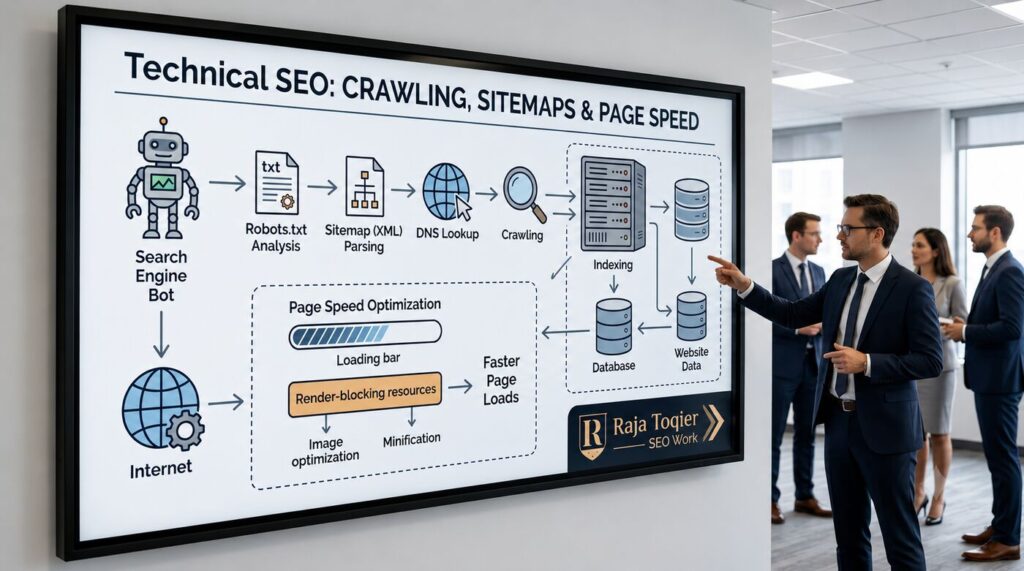
What Is Technical SEO?
Technical SEO is the practice of optimizing a website’s infrastructure, crawling, indexing, speed, and security so search engines can find, understand, and rank its pages.
If your beautifully designed website still isn’t ranking on Google, technical SEO is usually why. Technical SEO covers crawling, indexing, page speed, mobile experience, and security – the backend factors that let search engines find and understand your pages. Think of it like the wiring and plumbing inside a house: visitors never see it, but if it’s broken, nothing else works properly. The same holds for your website – without good site architecture, even the best content and links won’t be able to do much for your rankings.
How Does Technical SEO Actually Work?
Technical SEO works through three interlocking layers: site architecture, crawl instructions (sitemap + robots.txt), and rendering; each one either opens or blocks a path for search bots. It depends on a well-defined site architecture, XML sitemap, and robots.txt files that tell the crawlers about the pages that are worth visiting and those that are not. The right combination of all three will ensure that search engines spend their crawl budget on the most valuable pages of your website.
Build a Clean, Logical Site Architecture
Site architecture ensures that it is easy for users and bots to navigate your website without getting lost in the process. It is recommended that you have the following:
- Place key web pages no further than three clicks away from the homepage.
- Organize content into distinct categories and sub-categories.
- Ensure a consistent and descriptive navigation bar.
- Do not have any orphaned webpages with no inbound links.
Submit an XML Sitemap and Configure Your Robots.txt File
The two documents function as a map for the search engine. Here’s how to get them right:
- Create a new XML sitemap that contains all the indexed pages.
- Submit the XML sitemap using Google Search Console.
- Use the robots.txt file to exclude low-quality pages such as admin login pages or duplicate filters.
- Do periodic tests on both files to avoid crawl issues.
Why Do Page Speed and Core Web Vitals Matter for Rankings?
Page speed and Core Web Vitals matter because Google uses them as direct ranking signals and as a measure of user experience. Slow sites will make users irritated, increase the bounce rate, and inform the search engines that your pages are not worthy of being featured at the top, even if the content is great.
Google’s Core Web Vitals benchmarks target a Largest Contentful Paint (LCP) under 2.5 seconds, an Interaction to Next Paint (INP) under 200 milliseconds, and a Cumulative Layout Shift (CLS) score under 0.1.
Improve Your Website Loading Speed
- Compress and resize images before uploading them
- Enable browser caching and use a content delivery network (CDN)
- CSS Minification, JS Minification, and HTML Minification
- Remove unnecessary redirections and third-party scripts
For those who are looking for more information about speed and structure optimizations, our article about technical SEO checklist for 2026 provides useful information and benchmarks that can be used this year.
What Is the Difference Between General SEO and Technical SEO?
General SEO and technical SEO work toward the same goal but focus on different layers of your website. The table below breaks down where each one applies.
| Focus Area | General SEO | Technical SEO |
| Primary Goal | Attract and engage readers | Help search engines crawl and index pages |
| Common Tasks | Keyword research, content writing, backlinks | Site speed, sitemaps, schema, mobile optimization |
| Where It Lives | Blog posts, landing pages, meta content | Site code, server settings, file structure |
| Impact if Ignored | Weaker content relevance | Pages may not get indexed at all |
In short: general SEO earns attention, technical SEO earns access.
What Common Technical SEO Issues Should You Fix First?
Common problems include those related to duplicate content, lack or incorrect canonicalization, internal and external broken links, and inconsistent URL structure optimization. Left unresolved, these problems confuse search engines about which version of a page to rank, wasting authority that should be building your rankings.
Fix Duplicate Content With Canonical Tags
- Find pages with overlapping content with a crawl tool
- Insert a canonical link to each page pointing to its preferred version
- Merge near-duplicate posts on your blog if possible
Repair Broken Links and Clean Up URL Structure
- Crawl your website to find 404 errors
- Set up a 301 redirect for expired or deleted pages as part of your broken link management process
- Ensure that the URL is concise, uses lowercase, and contains keywords
If you would like to go into more detail about each of these problems, a technical SEO audit checklist will show you which pages need fixing.
How Do SSL Certificates and HTTPS Improve Your SEO?
Having SSL certificates improves your SEO performance since they provide the possibility to use HTTPS, which means better data protection for your visitors and has long been considered a ranking factor by Google. Websites that still rely on the insecure HTTP protocol generally suffer from low trust scores, security warnings in their browsers, and low conversion rates.
Migrate to HTTPS the Right Way
- Get the SSL certificate and install it
- Change all internal links and canonical tags to the HTTPS protocol
- Use 301 redirects from HTTP to HTTPS throughout the website
- Resubmit an updated XML sitemap in Search Console
Why Are Mobile Optimization and Structured Data Important in 2026?
Optimization of mobile sites and the use of structured data are important since Google first crawls the mobile version of the site, while structured data allows creating featured snippets in the form of FAQs and rating stars. As more websites rely on dynamic scripts, JavaScript rendering capabilities also determine whether search engines can actually see your content the way visitors do.
Implement Structured Data and a Strong Internal Linking Strategy
- Add schema markup for your articles, products, or FAQs on your webpages
- Perform testing of structured data through Google Rich Results Test
- Plan an internal linking strategy
- Make sure that your JavaScript code is crawlable by search engines
SEO is important to compete with other companies. If you market some kind of software or SaaS product, our SEO for tech companies guide can tell you how to use both technical and content SEO to rank higher than competitors.
How Often Should You Run a Technical SEO Audit?
Almost any website will need to be audited at least two times a year. Conducting monthly reviews will assist in discovering crawl errors, performance issues, and broken links. The algorithms of search engines are updated on a constant basis. There might be some problems with the backend of your website that can influence its ranking; however, you won’t find out about them until you conduct a technical SEO audit.
For more detailed information about checklists and prioritization frameworks used in technical SEO audits, you may refer to articles such as Semrush’s technical SEO toolkit.
There is no quick fix when it comes to technical SEO. The nature of search engines, browsers, and the expectations of users is always changing, and that is why it becomes important to maintain and update your website’s foundation on an ongoing basis. Should you prefer to outsource the process to professionals, you can get in touch with our team at any time.
Frequently Asked Questions
Technical SEO is the process of optimizing website infrastructure, including the speed, crawlability, indexing, security, and code, to make the webpages easily discoverable and understandable by the search engine algorithms.
A common example is fixing a broken XML sitemap so Google can discover all of a site’s pages, or compressing images to improve page speed and Core Web Vitals scores.
SEO is far from being dead – it has just become more sophisticated. Modern search engines take into account structured data, AI-powered summaries, and performance factors to determine the ranking of websites.
SEO is the broad practice of improving visibility in search results, including content and backlinks. Technical SEO is a type of SEO that concentrates exclusively on website infrastructure, coding, and backend optimization.
AI has changed SEO, but hasn’t killed it yet. The search engines still need a good site architecture, fast load speed, and structured data – all of which are parts of technical SEO.