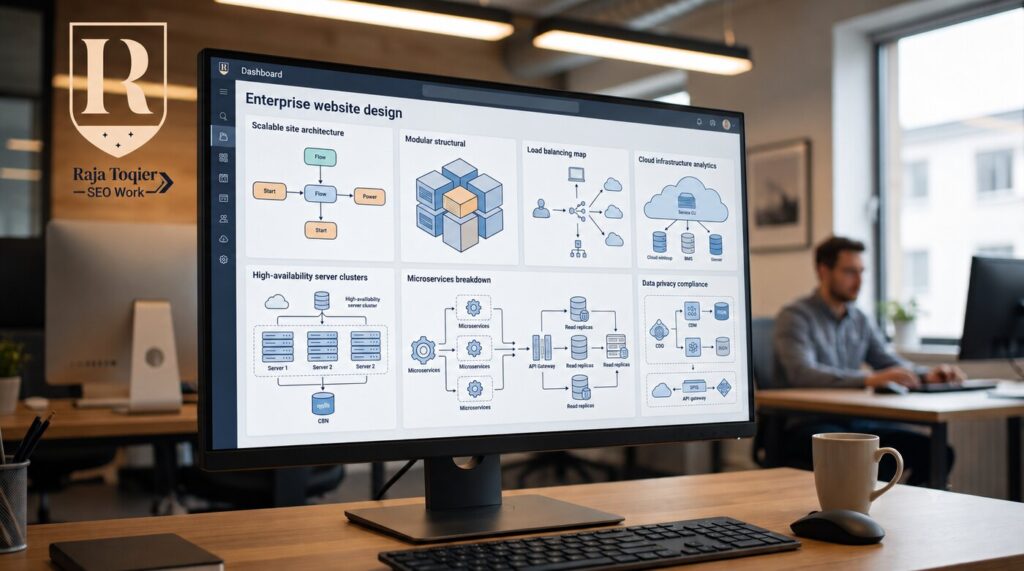
What Is Enterprise Website Design?
Enterprise website design is the planning, building and maintenance of a large-scale enterprise website that supports thousands of pages, multiple business units and heavy traffic without sacrificing speed or security. It combines a resilient website architecture, a flexible content management system (CMS), and enterprise-grade infrastructure to give large organizations a scalable, high-performance digital presence across every channel.
For large organisations, a website is rarely just a single shopfront. It is a network of connected properties to support sales, HR, investor relations, and customer support, all of which require the same web development standards, shared design systems, and one source of truth for content. Getting this right is what separates a site that scales gracefully from one that buckles under its own growth.
Why Do Large Businesses Need a Different Approach to Web Development?
Large businesses work across regions, departments and product lines. A single template or theme can’t handle this volume of content and complexity. They need scalable infrastructure capable of handling traffic spikes, multiple content editors, and compatibility with current business solutions without any downtime.
Build on Infrastructure That Grows With the Business
In general, a future-proof foundation is made up of:
- Cloud hosting with auto-scaling to absorb traffic surges
- Decoupled or hybrid Content Management System (CMS) that separates the content from the presentation
- Central asset & brand libraries shared across all sub-sites
- Staging and versioning environments for safe deploys
What Makes an Enterprise Website Different From a Small Business Site?
The key difference is scale: an enterprise site handles far more content, users, and integrations than a small business website, and it’s built from the ground up to meet more rigorous security and compliance standards.
| Feature | Enterprise Website | Small Business Website |
| Page volume | Thousands of pages across departments | Typically under 50 pages |
| CMS complexity | Multi-user, role-based CMS or DXP | Simple single-admin CMS |
| Traffic capacity | Built for high, fluctuating traffic loads | Built for steady, moderate traffic |
| Security needs | Multi-layered security vault, compliance audits | Standard SSL and basic firewall |
| Integrations | CRM, ERP, marketing automation, APIs | Few or no third-party integrations |
| Timeline & investment | Multi-month build, larger budget | Weeks to launch, smaller budget |
Match the Platform to the Scale of the Business
Choosing a suitable platform at an early stage is important to save costs associated with migration later on. This is why many big companies consider a Digital Experience Platform (DXP) rather than a common CMS. A DXP integrates content, personalisation and analytics across web, mobile and app experiences in one system.
Popular enterprise-grade platforms include Adobe Experience Manager, Sitecore, Contentful, and WordPress VIP, each offering different levels of personalisation, multi-site management, and API flexibility, so the right fit depends on the organisation’s content complexity and existing tech stack.
How Do You Build a Scalable, High-Performance Enterprise Website?
A scalable enterprise website starts with a ground-up redesign based on real user research, and a modular architecture that can accommodate new pages, languages and integrations without a rebuild.
Follow a Structured, Phase-by-Phase Build Process
- Website audit and mapping of the requirements for each person involved
- Information hierarchy creation among departments and website structure
- Choosing a CMS or DXP capable of multi-publishing
- Design with mobile-first principles for every breakpoint
- Creating reusable components for brand uniformity
- Improving website loading speed using caching, CDNs, and image compression
- Test for security, accessibility and QA before you launch
- Turn over to WebOps for continued monitoring and releases
Businesses that follow this process consistently report smoother rollouts, fewer post-launch fixes, and measurably better User Experience (UX) and conversion outcomes.
What Security and Compliance Measures Protect an Enterprise Website?
That’s where multi-layered security steps in, protecting an enterprise website by combining encryption, monitoring, and access controls, alongside data privacy compliance practices that meet regulations such as GDPR and CCPA.
Layered Security From the Network to the Content Editor
- SSL/TLS encryption and a web application firewall (WAF)
- Strong access control for users with role-based permissions for editors and admins
- Automated backups and disaster recovery processes
- Regular vulnerability scans and patch management
- An advanced technical SEO setup that includes crawl control and structured data governance
This typically includes alignment with recognized standards such as SOC 2 Type II, ISO 27001, and WCAG 2.1 accessibility guidelines, which strengthen both compliance posture and user trust.
The same security-first principle applies across industries – from regulated financial platforms to global e-commerce operations – where trust and compliance directly influence conversion rates.
What Results Can Enterprise Businesses Expect From a Redesign?
A properly designed enterprise website gives you an omnichannel digital experience, better page speed, and automated business workflows that minimize the manual publication work of the team.
Expect Measurable Gains Across Search, Speed, and Conversions
- Better search rankings from improved Search Engine Optimization (SEO) foundations
- More relevant on-site search results powered by predictive search algorithms
- Lower bounce rate with fast and mobile-optimized pages, in line with Google’s Core Web Vitals guidance
- Consistency in brand identity for departmental or regional subsites
Organizations that treat their website as core infrastructure – not just a marketing asset – see compounding gains in speed, reliability, and search visibility over time.
Enterprise Website Design Examples Worth Studying
Looking at large, well-known websites can inspire your own design choices. These three show how big organizations keep complex information clear.
IBM
IBM organizes its many products and services into a large menu with clear groups. The lesson: when you have a big catalog, group it clearly so visitors can find their way without feeling overwhelmed.
Adobe
Adobe shows its software at work, with images of its products on the homepage. The takeaway: showing your product in action often explains more than a long paragraph about features.
HubSpot
HubSpot puts a clear call-to-action button on its homepage, with text like “Get started free”. The lesson: make the next step obvious, so visitors know where to click.
These sites work in different markets, yet all three keep navigation clear and the next step obvious. Even a very large organization can give visitors a simple, easy experience.
Rental businesses have different needs. See which features drive bookings in our guide to enterprise rental website design.
Building an enterprise website is a long-term investment in infrastructure, security, and brand consistency, not just a one-time design project. If your organization is ready to plan a scalable, high-performing site, visit our enterprise website design services page, explore more of our work on the Rajatoqier homepage, or get in touch with our team to start the conversation.
Frequently Asked Questions
An enterprise site is a wide website designed for an enterprise that deals with many pages and departments as well as receives huge traffic.
Enterprise SEO deals with thousands of pages, multiple sub-domains and cross-functional teams – all of which need automation and governance. Traditional SEO usually deals with a smaller site and far fewer stakeholders.
Some of the common kinds are informational sites. E-commerce sites, portfolio sites, and web applications, while enterprise websites incorporate more than one of these kinds of websites in one single website.
Enterprise is always an organization that makes a lot of money and consists of a number of departments and customers. Like a retailer of the nation, bank all around the world, or a logistics firm across nations.
In general terms. Websites are classified into three main categories of static websites, active websites, and web applications, and mostly enterprise websites use shifting architecture based on CMS.