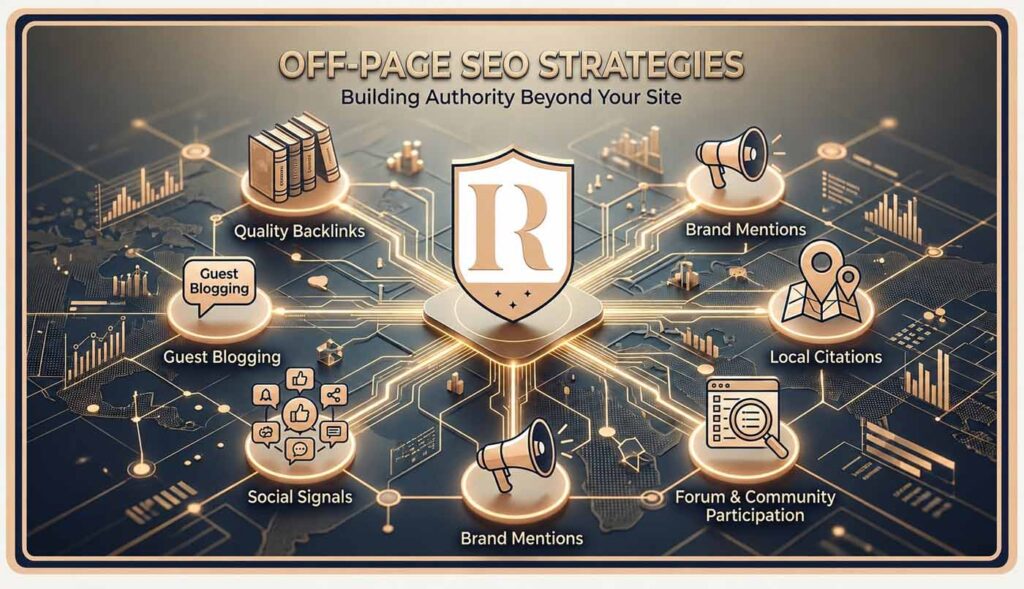
Offsite SEO is the set of ranking signals search engines gather from outside your own website – backlinks, brand mentions, citations, and social proof – that tell Google whether your site is reputable enough to rank. If you’ve optimized every page on your site and still can’t break into the top results, this is almost always why: on-site SEO tells Google what your content is about, but offsite SEO tells Google whether anyone else considers that content worth trusting.
Search engines evaluate hundreds of signals from other websites that relate to yours: who links to you, what people say about your brand, whether your backlink profile looks reputable, and whether other sites treat you as an expert in your field. Sending the right signals requires a strategy, consistent application of said strategy, and knowledge of what approaches work in 2026 – counting links isn’t enough.
Onsite vs Offsite SEO: Understanding the Full Picture
Before getting into optimization techniques, let’s clarify two different fields that are often confused by many people. On-page SEO (also known as on-site SEO) refers to all actions within your website that you have direct control over, such as meta tags, headings, load speed, interlinking and content itself. Offsite SEO is about your reputation across the rest of the web. For a deeper breakdown of how the two interact, Moz’s community discussion on onsite vs offsite SEO is a useful reference.
The two work together, not separately. A beautifully optimized site with zero authoritative backlinks will struggle to rank. In addition, having a well-structured website is also important, as otherwise all your backlink efforts will be in vain. If you haven’t conducted an on-page analysis of your website yet, try our On-Page SEO service package
How Does Offsite SEO Help Your Website Rank Higher?
Every good backlink, brand mention, customer review, local listing, and social share sends Google a signal. Picture two sites with near-identical content:
Website A has: hundreds of quality backlinks, industry mentions, an active Google Business Profile, social activity, and a good online reputation.
Website B has: excellent content, no backlinks, no third-party authority, and almost no online presence.
Google trusts Website A more because other authoritative sites are validating its expertise – which is exactly what makes off-page SEO one of the strongest ranking signals in 2026. The measurable advantages include:
- Better keyword rankings
- Higher Domain Authority
- More qualified referral traffic
- Improved brand awareness
- Stronger E-E-A-T signals
- Faster indexing of new content
- Greater customer trust
- Higher conversion rates
Paired with solid on-page SEO, these effects compound into sustainable organic growth.
What Are the Core Components of a Successful Offsite SEO Strategy?
Offsite SEO today is no longer about collecting any kind of backlink – it’s about building a credible online presence across many ranking factors, with backlinks as the foundation.
Build High-Quality Contextual Backlinks Naturally
Quality beats quantity every time – one link from a genuinely reputable site can outweigh dozens of weak ones. High-quality links typically come from:
- Industry blogs
- News publications
- Educational websites
- Business associations
- Resource pages
- Editorial mentions
- High-quality guest posts
Rather than chasing a thousand backlinks, earn the ones your content deserves through:
- Conducting original research
- Creating evergreen guides
- Building helpful tools or calculators
- Offering expert commentary to journalists
- Writing genuine guest posts
- Replacing weak links with stronger ones
- Producing infographics other sites link to naturally
Strengthen Your Domain Authority and Website Credibility
Domain Authority isn’t a direct Google ranking factor, but it’s one of the best available proxies for how much trust your site has earned. It improves through:
- High-quality content creation
- Building real industry relationships
- Removing toxic links
- Earning editorial links
- Developing topical authority
- Natural anchor text distribution
The more authority you hold, the easier it becomes to rank for competitive keywords.
Earn Brand Mentions Beyond Traditional Link Building
Google has gotten very good at recognizing brands even without a hyperlink attached – these are unlinked brand mentions. Examples include:
- News articles about your business
- Podcast interviews
- Industry roundups
- Social media discussions
- Business directories
- Online reviews
Though they don’t have any link value themselves, they establish credibility and reputation. When businesses regularly appear in reliable sources, they create their authority gradually.
Ready to build authority the sustainable way?
Why Is Link Building Still One of Google’s Strongest Ranking Signals?
Google was initially built on linking websites, and although its algorithms have been improving since then, backlinks are still among the most reliable trust signals, where each one is basically like a recommendation. But Google now weighs many additional factors when evaluating a link:
| Factor | Low-Quality Link | High-Quality Link |
|---|---|---|
| Relevance | Unrelated website | Same industry |
| Authority | New or spammy site | Trusted publication |
| Anchor Text | Keyword-stuffed | Natural wording |
| Placement | Footer/sidebar | Editorial content |
| Traffic | No visitors | Real organic traffic |
| Trust | Low | High |
It’s no longer about the raw number of backlinks – it’s about earning different, high-quality ones through multiple channels.
At a Glance: Offsite SEO Tactics and Their Primary Benefits
| Tactic | Primary Benefit |
|---|---|
| Guest Posting | Earns editorial dofollow links; builds brand authority |
| Digital PR | Mass link acquisition; referral traffic at scale |
| Local Citations | Improves local pack rankings; builds NAP consistency |
| Broken Link Building | White-hat links from relevant resource pages |
| Brand Mentions (Unlinked) | Strengthens E-E-A-T signals; feeds co-citation |
| Social Media Sharing | Increases content reach; drives referral traffic |
| Influencer Outreach | Authentic brand exposure; niche authority links |
| Forum & Community Engagement | Builds topical authority; earns nofollow referral value |
How Can You Build a Powerful Offsite SEO Strategy That Delivers Long-Term Results?
The way to authority is neither a shortcut nor a backlinking package that can be bought. The websites that will come out winners in 2026 gain their authority through valuable content, networking, and regular publication of knowledge on different platforms.
Create Link-Worthy Content That Naturally Attracts Backlinks
Instead of ordinary blog posts, produce resources that solve real problems or offer unique insight:
- Original industry research
- Measurable case studies
- Ultimate guides
- Statistics pages
- Free templates
- Checklists
- Interactive tools
- Infographics
- Step-by-step tutorials
As soon as the content receives sufficient authority, other websites automatically cite it, thus creating natural contextual links. Evergreen resources tend to keep earning links for years.
Use Guest Blogging to Expand Your Authority
Guest blogging is still one of the safest, most effective offsite tactics – provided you target reputable, relevant sites rather than any site that will publish you. A solid campaign includes:
- Relevant websites in your niche as targets
- High-quality, genuinely valuable content
- Contextually relevant links
- Real relationships with editors
- Content that establishes expertise
- A path back to referral traffic
Skip duplicate or promotional filler – publish content that actually helps the host site’s readers.
Strengthen Local SEO with Business Citations
If you serve customers in a specific city or region, local citations belong in your offsite SEO plan. A citation is any online mention of your business name, address, or phone number (NAP), linked or not. Popular places to get local business mentions include Google Business Profile, Bing Places, Apple Business Connect, Yelp, industry directories, Chamber of Commerce listings, and local business directories. Keep your NAP consistent everywhere it appears. If local rankings matter to you, our Local SEO service covers this in depth.
Amplify Your Content Through Social Media
Social shares aren’t a direct Google ranking factor, but they widen the audience for your content – which increases the odds of earning backlinks, brand mentions, and referral traffic. The amplification process needs to include the publication of content on LinkedIn, Facebook sharing, content posting on X, content creation for Pinterest, video creation for blog articles, and sharing in niche professional groups. A solid content marketing strategy is one of the highest-leverage investments you can make here.
Monitor Unlinked Brand Mentions
There is a large number of websites that mention your business but do not have any backlink to it. This is an opportunity rather than a dead end and you need to monitor all such mentions regularly, paying attention to mentions of your company name, products, founder, website, branded keywords, and then send a request politely asking for a link.
Let’s build high-authority backlinks together.
Nofollow vs Dofollow: What Really Matters in Your Backlink Profile
Your backlink profile will consist of dofollow links that directly transfer authority to your website and nofollow links that are marked with the HTML attribute instructing search engines not to transfer authority – but that does not mean that nofollow links aren’t worth anything at all. Both types should be present in a good backlink profile in 2026. An entirely dofollow backlink profile from several sources is going to be perceived as spam by Google; even nofollow links from high-traffic websites drive visitors to your site and support E-E-A-T. Don’t try to create a specific dofollow-to-nofollow ratio; concentrate on acquiring relevant links.
Which Offsite SEO Techniques Work Best in 2026?
New tactics come and go, but the strategies grounded in Experience, Expertise, Authoritativeness, and Trustworthiness (E-E-A-T) keep delivering results.
Build Relationships Instead of Just Backlinks
The most valuable backlinks come from people who know you. Engage with bloggers, journalists, hosts of podcasts, influencers, business associations, professionals – networking is the path to collaborations, interviews, mentions in expert round-ups, and editorials.
Invest in Digital PR Campaigns
Digital PR combines regular PR and modern SEO – instead of asking for a backlink, you create valuable content. These are original surveys, research in the niche, annual research about trends, visual data, charity projects, community efforts, and commentary on news topics. Editors always prefer to link to original research instead of promotional content – editorial pieces can provide some of the best backlinks out there.
Diversify Your Anchor Text Distribution
Anchor text diversity is one of the most overlooked ranking factors – repeating the same keyword phrase link after link looks unnatural. A healthy profile blends:
| Anchor Text Type | Example |
|---|---|
| Branded | Raja Toqier |
| Naked URL | rajatoqier.com |
| Generic | Learn more |
| Partial Match | professional off-page SEO services |
| Exact Match | off site seo |
| Long-Tail | discover proven off site SEO strategies for 2026 |
Natural variation helps search engines read your content correctly while reducing over-optimization risk.
Regularly Audit Your Backlink Profile
Once you get some links, it doesn’t mean that the job is done. A monthly audit will help you find toxic links, broken links, lost links, new referring domains, competitors, and problematic anchor texts. Experienced SEO always check their backlink profile at least once a month in order to keep domain authority growing in the proper direction.
Social Media, Referral Traffic, and the Indirect SEO Impact
Social networks usually use nofollow links and don’t provide any link equity; however, to neglect social media in the context of SEO would be a big mistake. Viral posts on LinkedIn, X, Reddit, or other social networks bring you closer to journalists, bloggers, and site owners who will link to you in the future. Beyond that, social channels drive referral traffic – visits that arrive from somewhere other than Google. Social signals don’t directly move rankings, but strong referral traffic and engagement demonstrate real audience appeal, which tends to show up in SEO performance indirectly over time.
How Can You Measure the Success of Your Offsite SEO Campaign?
Starting a campaign is only the beginning – sustaining results means tracking performance and adjusting course. Backlink count matters far less than the health and authority of your overall link profile, brand reputation, referral traffic, and engagement.
Monitor the Most Important SEO Metrics
- Growth in referring domains
- Number of high-authority backlinks
- Domain Authority (DA) or Domain Rating (DR)
- Organic keyword rankings
- Referral traffic from backlinks
- Brand mentions across the web
- Google Business Profile interactions
- Organic conversions and leads
- Click-through rate (CTR)
- Indexed pages and crawl health
Examining these every month reveals patterns and ensures decision-making is based on data and not assumptions.
Use Professional SEO Tools
A proper tool set helps to connect opportunities, detect toxic backlinks, and monitor keyword rankings and overall SEO performance. Among frequently used SEO tools are Google Search Console, Google Analytics 4, Ahrefs, Semrush, Moz, Screaming Frog SEO Spider, and Majestic.
What Are the Most Common Offsite SEO Mistakes to Avoid?
Many sites stall out because they apply outdated or risky tactics without realizing it. Avoiding these keeps your authority growth sustainable.
Buying Low-Quality Backlinks
Using bulk cheap backlinks seems to be the right way, but most often it causes trouble afterwards. Spammy backlinks tend to appear from Private Blog Networks (PBNs), link farms, low-quality directories, irrelevant foreign websites, and automated backlink generators. Put that effort into earning editorial backlinks from credible sources instead.
Ignoring Link Relevance
A link from a credible site in your niche is worth far more than dozens of irrelevant ones – a digital marketing blog linking to an SEO company is relevant; a gambling site linking to a local plumber is not. Prioritize topical relevance over raw link count.
Over-Optimizing Anchor Text
Repeating the same keyword as anchor text signals manipulation. Do it naturally by including a mix of brand name backlinks, naked URLs, plain words, keyword partial matches, and long-tail variations.
Neglecting Online Reputation
SEO isn’t only about backlinks – reviews, ratings, mentions, and general social proof shape both user perception and how search engines read your credibility. Ask satisfied customers for honest reviews and engage with them online.
Forgetting About Content Promotion
Great content that nobody knows about earns no links. Spread each new piece through your email newsletter, social networks, industry-specific forums, professional networks, influencers, and digital PR – regular promotion is the key to the success of any content in terms of backlinks.
What a Strong Offsite SEO Programme Looks Like Month by Month
The most frequent offsite SEO mistake is making it a one-time event instead of continuous practice. This is how the month-by-month schedule should look for a business in its growth stage:
Month 1–2: Backlink audit, competitor gap analysis, and identification of easy citation opportunities.
Months 3 & 4: Outreach for guest posting, local citation development, and planning of a digital PR campaign.
Months 5 & 6: Variety of anchor text, disavow toxic links, and check your domain authority.
Ongoing: Building relationships with editors, amplification of social media content, and regular tracking of referral traffic and keywords.
A structured cadence like this builds a backlink profile that grows sustainably, rather than spiking and dropping in a pattern Google has gotten very good at identifying and penalizing.
Why Is E-E-A-T More Important Than Ever for Offsite SEO?
E-E-A-T signals will continue to be Google’s priority in 2026, and most of them come from external sources. Google doesn’t just read your About page; it checks whether other trusted sources corroborate your expertise.
Demonstrate Real Experience
Share insight drawn from genuine, first-hand experience. It reads as authentic to both users and search engines.
Showcase Your Expertise
Offer content that thoroughly answers questions that your audience may have. It should be well-researched, contain statistics, expert opinions, personal experience, and tips – the more valuable your content is, the better chance you have of acquiring backlinks from editors.
Build Authoritativeness
Authority comes through repeated recognition by trusted sources: guest blogging, participation in industry conferences, interviews on podcasts, published papers, digital PR, quality backlinking, and topic-specific authority. To gain it, you need to create an author bio on credible websites (LinkedIn, blogs, podcasts) and be interviewed and featured in roundtables.
Earn Trust Through Transparency
Trust goes further than backlinks. Make it grow through contact information accuracy, HTTPS encryption, author bios, a clear privacy policy, real client reviews, and consistency of your business info throughout all directories and platforms. It is especially crucial for YMYL (Your Money, Your Life) categories finance, healthcare, and law – where Google puts additional checks regarding the credibility of sources, and offsite reputation may determine whether or not your site gets indexed.
Grow your rankings with offsite SEO.
What Is the Future of Offsite SEO Beyond 2026?
Search algorithms get better at judging quality every year. Backlinks will keep mattering, but the trajectory of SEO is toward authority, trust, and brand recognition. Those companies that create valuable content, get coverage in media, develop industry relations, and provide a great user experience will continue beating the competition, which is using outdated strategies.
Offsite SEO doesn’t end after an initial push – it’s an ongoing process of building brand reputation. Every backlink, review, brand mention, and satisfied customer adds to your trust signals and compounds organic growth over time.
Start Building Your Offsite Authority Today
Brands leading in organic search are those who have earned the most trust from search engines and users all over the web. And this is done through offsite SEO: link after link, mention after mention, citation after citation. At rajatoqier.com, we help businesses of every size build an online presence that attracts consistent organic traffic. Whether you need a full offsite SEO programme or just a starting point, get in touch – we’re happy to help.
Frequently Asked Questions
Off-page SEO covers the optimization actions taken outside your website to improve its search ranking – link building, brand mentions, digital PR, citations, social promotion, and reputation management. It’s how search engines judge how trustworthy and authoritative your site actually is.
Best offsite SEO practices consist of gaining backlinks, guest blogging, executing digital PR campaigns, creating content that gets shared widely, getting local citations, optimizing your Google My Business profile, monitoring unlinked mentions of your brand, leveraging social media to promote your content, and using natural anchor text.
No – link building is one component of off-page SEO. A complete offsite strategy also includes brand mentions, local SEO, social signals, online reviews, digital PR, influencer outreach, citation building, reputation management, and other trust-building work that strengthens your site’s authority.
Firstly, you need to create content that is worth linking to. Get backlinks via guest blogging, digital PR, outreach, and partnership marketing. You can do local citations, optimize your Google Business Profile, get customer testimonials, market your content via social media, monitor brand mentions, and conduct backlink audits.
Yes – it continues to be one of the key ranking factors for Google in 2026. Even as algorithms change, the importance of backlinks, authority, trust factors, brand awareness, and E-E-A-T in rankings persists, with businesses that adopt a principled and strategic approach to off-site SEO continuing to thrive.