How Do You Choose the Best Ecommerce Website Platform for Your Business?
Selecting the right e-commerce website platform requires aligning your budget, technical capabilities, and business needs to what the actual platform offers. The right platform gives you built-in SEO tools, mobile-first responsive store design, secure checkout, and room to scale, without locking you into an expensive redesign a year from now. Get this one decision right, and almost everything else about running your store gets easier.
That’s the short answer. Now let’s walk through exactly how to get there, platform by platform and feature by feature, so you can make a choice you won’t regret twelve months from now.
Why Does Your Ecommerce Platform Choice Matter So Much?
Most business owners pour their energy into product photography and ad spend, then treat the platform underneath as an afterthought. That’s backwards. Your platform is the engine running everything else: page speed, inventory management, search visibility, and checkout flow all trace back to this one decision.
The Real Cost of Getting the Platform Wrong
The wrong ecommerce platform isn’t just a nuisance but adds up to:
- Slow load times push shoppers away before they even see your products
- Poor inventory management results in over-selling and refund issues
- A lack of solid SEO foundation means that organic traffic takes months to be noticed
- Outdated checkout flows tank your Conversion Rate right when a customer is ready to buy
Taking time to research and compare platforms early on is one of the most strategic moves an e-commerce business owner can make. If you’d like to see the kind of results that we deliver with a full optimization of your build architecture and checkout process, our ecommerce website design team has years of experience building sites that move fast, get found, and convert.
Talk to Our Ecommerce Website Design Team
What Should You Look for in an Ecommerce Website Builder?
A good Website Builder needs to do more than let you upload products. It should provide a robust Digital Marketing Strategy from start to finish. Here are the factors that actually move the needle.
Ease of Use and Store Management
Not every business owner is a developer. The platform must provide an intuitive dashboard, drag-and-drop site creation, product uploads, and order management processes that aren’t overly complicated.
Mobile-First Responsive Store Design
More than 60% of online shopping now happens on a phone. Creating a mobile-first responsive design of the store is not an option anymore since Google also follows mobile-first indexing when ranking your site.
Built-In Search Engine Optimization (SEO) Tools
A beautiful yet unknown store equals wasted money. Your platform must have SEO features such as editable meta titles and descriptions, SEO-friendly URLs, fast-loading page speed, and structured data compatibility in order for you to be able to create both converting and SEO-friendly store designs.
Payment Gateway Integration and Secure Checkout
A secure payment gateway is the foundation of every good online store. Your platform should provide for multiple payment options, credit/debit cards, digital wallets, and Buy Now Pay Later services with Secure Transaction Processing Protocols, such as SSL encryption and PCI Compliance. A poorly organized and inconsistent checkout process causes customers to leave their cart quickly, and that is exactly what a Seamless Checkout User Experience is about.
Scalability Across a Multi-Channel Retail Ecosystem
Your online store needs to scale along with you. A scalable platform handles traffic spikes, catalog expansion, and new sales channels, think social storefronts, marketplaces, and in-person point of sale, without a full rebuild. Cross-Selling within the Multi-Channel Retail Ecosystem is becoming more common practice than a rarity, and many emerging businesses will inevitably come to require something a little more complex and robust as they grow.
Customization, Branding, and User Experience (UX)
Your e-commerce platform is an extension of your brand identity. The best platforms offer deep customization, from templates to fully custom-coded themes, so your store doesn’t look like every other shop built on the same theme. Good UX design inspires confidence and loyalty among customers at each step of the Buyer’s Journey.
Conversion Rate Optimization Features
Traffic without conversions is just noise. Be sure that the platform supports the tools you’ll need to recover abandoned carts, provide personalized recommendations, create urgency with countdown timers, and ensure an easy-to-use single-page checkout. Even small Product Page Optimization Techniques like better images and copy can increase your conversion rates substantially.
Request a Free Platform Audit?
Is Shopify Still the Best Ecommerce Website Builder in 2026?
For most small and mid-sized businesses, yes, Shopify remains the platform most people picture when they think of a best-in-class E-commerce Website Design solution, and for good reason. There is no other tool on the market that strikes this balance quite like it.
Why Shopify Works for Fast-Growing Stores
Thousands of apps are supported by Shopify; it has native Payment Gateway support and even comes with built-in analytics to measure performance. To learn more about building an amazing store interface on this platform, our 10 essential tips for stunning Shopify website design will certainly help you out. If you want some of the latest updates from this platform and helpful tips for e-commerce websites, the Shopify blog can be useful too.
Which Ecommerce Platform Actually Fits Your Business?
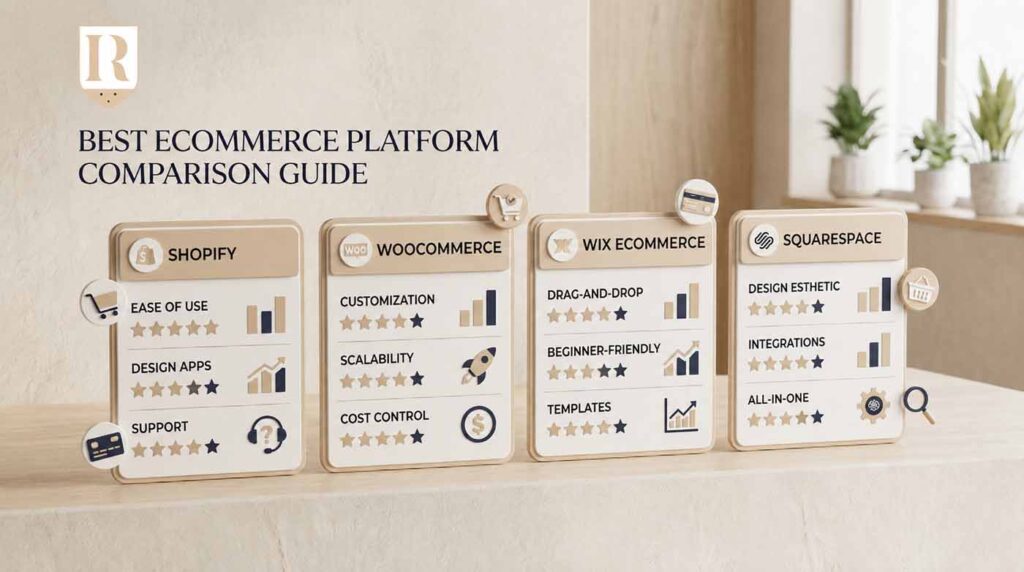
Not all platforms fit all businesses, and there is no “best” one; each business needs its own unique platform, depending on many factors including the number of products and the budget. Here is a quick side-by-side comparison to help you think it through.
| Platform | Best For | Key Strength |
| Shopify | Small to medium businesses, dropshipping, fast launches | User-friendly interface and a huge app ecosystem |
| WooCommerce | WordPress users who want full content flexibility | Deep customization on top of WordPress content marketing |
| Magento / Adobe Commerce | Enterprise catalogs, multi-currency, multi-region | Enterprise-grade power and flexibility |
| BigCommerce | Growing stores that want strong native SEO | Built-in SEO tools with no added transaction fees |
| Custom-Built Platform | Businesses with unique workflows or requirements | Maximum flexibility, built from scratch |
How Can a Professional Web Design Agency Help You Build the Best Ecommerce Website?
The right choice of platform may become the first step to success, but that does not guarantee anything until you make sure the rest of the work is done. The proper E-commerce Website Design team takes care of both aspects and combines design strategy with execution and User Experience to create award-winning digital shopping experiences.
What a Strong Agency Adds on Top of the Platform
- High-Converting Online Store Layouts built around how your customers actually shop, not generic templates
- Effective Strategic Content Marketing for Retail that works throughout all stages of the buying process
- Comprehensive Marketing Automation Systems including abandoned carts and re-engagement funnels
- Ongoing Content Marketing support so your product pages and blog keep earning organic traffic
If you’re a smaller operation, this doesn’t have to mean an enterprise budget. Our small business website design services are tailored specifically for expanding retailers who require professional work without unnecessary enterprise costs.
Build Your Ecommerce Store the Right Way?
What Is the Best Ecommerce Platform for a Small Business?
As a small business owner, your main concerns include cost-effectiveness, timely deployment, and scalability. The Best E-commerce Platform for Small Business use cases should offer affordable pricing plans, no hidden transaction fees, and enough functionality to avoid additional paid apps during your first year of operation.
Pay attention to SEO friendly, mobile-optimized, and secure from any payments perspective. In the future, you need to ensure you can scale up or switch to another solution without losing your organic search ranking position.
What Common Mistakes Should You Avoid When Building an Ecommerce Store?
But even experienced entrepreneurs still make mistakes that could have been avoided at the launch of a new store. For the full rundown of what to check before you even start building, see our guide on 5 things you must know before creating an online store. Watch out for these:
- Ignoring page speed: slow stores drive customers away at once, so choose a builder that has fast performance as its default
- Ignoring SEO configuration: launching a website without SEO setup means losing several months of potential traffic
- Trying to save money at any cost: low-priced solutions can be expensive in terms of transaction fees or limited possibilities of customization
- Overlooking mobile: only desktop version is not suitable for any store anymore
- Underestimating security: Customers trust you with their payment data, so weak security can end that trust overnight
How Much Should You Realistically Budget to Build a Good Ecommerce Website?
For a few hundred dollars you can create a quite basic store with an off-the-shelf theme and default configuration options. But such an approach usually doesn’t include customization, SEO configuration, and special conversion-oriented features. The more realistic estimate for a well-thought-out store that should convert would be higher and depends on your catalog volume and specific features. The important point is not how little you can spend but how much revenue your store will bring after launching.
The right platform along with the right team of developers will help you turn your online store into your key sales channel. You do not need to manage everything yourself even if you are creating a startup or changing a platform. Find all the information about our services on our homepage or contact us to get your free consultation. The following table includes answers to the most common questions related to the choice of an eCommerce platform.
Frequently Asked Questions
No, there is no one-size-fits-all solution depending on the scale of your business and its goals. Shopify is generally the best all-around choice for most small to mid-sized businesses because it balances ease of use, design flexibility, and app support, while larger catalogs may be better served by Magento or a custom build.
Shopify or WooCommerce are the best starting points for the majority of eCommerce businesses. Shopify works well for those who like rapid and managed development, while WooCommerce would be a better choice for those who already use WordPress and need more content options.
Once again, it all depends on your business’s particular needs. BigCommerce has superior SEO capabilities with zero transaction costs, WooCommerce offers more content freedom to WordPress users, and Magento/Adobe Commerce outperforms Shopify in the case of complex companies.
The amount of $800 would be sufficient for a basic store with a ready-made template which requires little customization. In most cases, it does not include customization, SEO, and conversion optimization. It’s enough to get something live, but not enough for a store built to compete and convert long-term.
If you require an online store with advanced eCommerce capabilities, then Shopify would be a better solution. This service provides more powerful e-commerce features and has a more extensive app library.