What is On-Page Technical SEO? Bridging Source Code with Search Indexability
On-page technical seo is the practice of optimizing a webpage’s HTML source code, document structure, and backend rendering performance so search engines and AI crawlers can efficiently crawl, parse, and index its content. It mixes in classic ranking factors like title tags and header hierarchy, and modern priorities like DOM depth, Core Web Vitals, and structured data designed for generative search.
Get these fundamentals right and both traditional search engines and generative answer engines can find, understand, and trust your page. Get them wrong, and even the best-written content stays functionally invisible. That’s why our technical SEO services start with a full source-code and rendering audit before a single sentence of copy is touched – and it’s the same philosophy behind every checklist item below.
Structural Component Comparison: How On-Page Signals Map to Crawl and AI Retrieval
| On-Page Technical Component | HTML/DOM Implementation | Search Engine Crawl Function | AI Overview Retrieval Signal |
|---|---|---|---|
| Title Tag | <title> in <head> | Primary relevance anchor | Entity confirmation for citation |
| Header Tag Hierarchy (H1-H3) | Sequential <h1>-<h3> | Topical outline mapping | Chunk boundary for extraction |
| Schema Markup (JSON-LD) | <script type=application/ld+json> | Rich result eligibility | Direct entity/attribute parsing |
| Canonical Tags | <link rel=canonical> | Duplicate consolidation | Source-of-truth selection |
| Image Alt Text & Srcset | <img alt> + <picture> | Image index eligibility | Multimodal context grounding |
Machine-Readable Document Architecture: HTML5, DOM Depth, and Token Optimization
Most agencies stop at title tags and meta descriptions. What they miss is that modern AI search crawlers – GPTBot, ClaudeBot, and Gemini – don’t just index your page, they parse the entire DOM tree token by token. A bloated, deeply nested DOM burns crawl budget and token allowance before the crawler ever reaches your content. Keeping the tree flat protects your Crawl Budget Efficiency and directly improves how much of your page an AI system can actually digest in one pass. This structural discipline also strengthens overall Internal Link Architecture, which our on-page SEO strategy framework treats as a ranking factor in its own right, not an afterthought.
| DOM Architecture Strategy | HTML Node Threshold | Token Parsing Latency | AI Citation Impact |
|---|---|---|---|
| Flat semantic markup | < 1,500 nodes | Low | High — fully parsed |
| Deeply nested <div> soup | 3,000+ nodes | High | Low — often truncated |
| Hybrid CMS output (uncleaned) | 2,000–3,000 nodes | Moderate–High | Inconsistent |
Semantic HTML5 Hierarchy: Logical Tagging for Algorithmic Context
Wrapping content in <main>, <article>, and <section> instead of generic <div> tags gives both search engines and AI parsers a reliable map of what matters on the page. This, along with a clean Header Tag Hierarchy (H1-H3) creates parent-child node relationships that can be extracted by automated systems as standalone snippets.
- Exactly one <h1> per page, matching primary search intent
- Sequential H2s introduced as questions, never skipped levels (no H2 straight to H4)
- H3s framed as solution statements nested under their parent H2
- Semantic wrappers (<main>, <article>, <nav>, <aside>) replacing unlabeled <div> containers
- No orphaned headings used purely for visual styling
Optimizing Image Assets: Alt Attributes, srcset, and WebP Formats
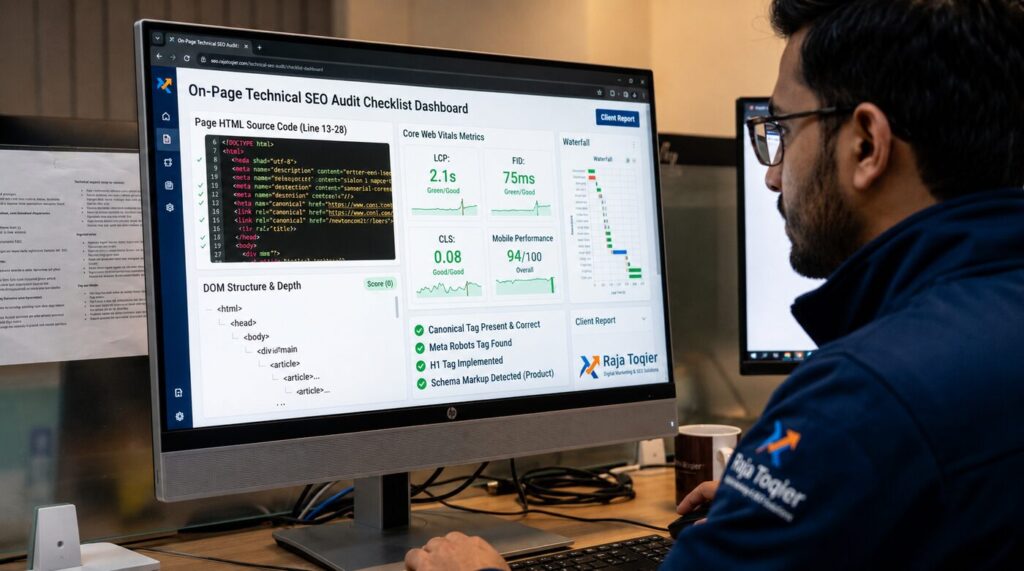
Visual assets are still a leading cause of poor Core Web Vitals scores. Using a responsive <picture> element to serve next-gen formats and a well-described alt attribute protects accessibility, Mobile-First Indexing performance and reduces Render-Blocking Resources on first paint.
<picture>
  <source srcset="hero.webp" type="image/webp">
  <img src="hero.jpg" alt="On page technical seo checklist dashboard"
       width="1200" height="630" loading="lazy">
</picture>
Advanced Schema Integration: Constructing Nested @graph JSON-LD Entities
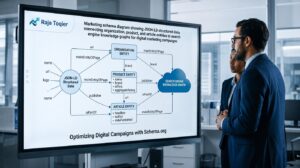
Most competitor content shows detached, single-entity Schema Markup (JSON-LD) fragments – a block for the article and a separate, unconnected block for the organization. Enterprise-grade implementation nests every entity inside a single @graph array so WebPage, Article, Author, and Publisher all reference one another by @id, giving crawlers an unambiguous entity graph instead of a pile of loose fragments. That is exactly the framework that our tech SEO in 2026 guide goes into more detail on.
{
  "@context": "https://schema.org",
  "@graph": [
    {
      "@type": "WebPage",
      "@id": "https://rajatoqier.com/technical-seo/#webpage",
      "url": "https://rajatoqier.com/technical-seo/",
      "name": "On-Page Technical SEO Checklist"
    },
    {
      "@type": "Article",
      "@id": "https://rajatoqier.com/technical-seo/#article",
      "isPartOf": { "@id": "https://rajatoqier.com/technical-seo/#webpage" },
      "author": { "@id": "https://rajatoqier.com/#organization" }
    },
    {
      "@type": "Organization",
      "@id": "https://rajatoqier.com/#organization",
      "name": "Raja Toqeer",
      "url": "https://rajatoqier.com/"
    }
  ]
}
Rendering Engineering: Core Web Vitals and Critical Rendering Path
Competitors treat Core Web Vitals as three abstract speed numbers. In reality, every metric is associated with a specific stage in the browser’s rendering pipeline – and it’s the choices made at the architectural level of Server-Side Rendering (SSR) that determine whether the Largest Contentful Paint (LCP) and Cumulative Layout Shift (CLS) are passing or failing, even before a single line of CSS has been written.
- Critical CSS Inlining – above-the-fold styles load with zero network round trips
- JS Hydration Deferral – non-critical scripts load after first paint
- LCP Element Optimization – hero image or heading is prioritized in the request chain
- INP/CLS Minimization – reserved layout space and deferred hydration prevent shifting
Eliminating Render-Blocking Resources: Inlining Critical CSS
| Approach | Render-Blocking External CSS | Inlined Above-the-Fold Critical CSS |
|---|---|---|
| First paint delay | High — waits on stylesheet download | Minimal — styles ship with HTML |
| LCP impact | Often fails 2.5s threshold | Typically passes comfortably |
| Maintenance | Simple, single file | Requires build-step automation |
Sites that skip this step are the same ones that show up in our SEO guide for tech companies as cautionary examples – strong content held back by an unoptimized rendering path.
Solving Main-Thread JavaScript Bottlenecks for INP & CLS Targets
If the main thread is busy with JavaScript, a page can download in under a second and still feel broken. Most URL Parameter Handling and interactivity problems actually come from differentiating passive HTML delivery from active script execution.
- Use defer on scripts that don’t need to block parsing
- Use async only for fully independent, non-DOM-dependent scripts
- Apply dynamic hydration so below-the-fold components hydrate on scroll, not on load
- Audit third-party tags quarterly – they are the most common source of main-thread blocking
Traditional SEO vs. Generative Engine Optimization: A Benchmark Comparison
Ranking well in classic search results and getting cited inside an AI Overview are related goals, but they’re measured differently. A page can satisfy Robots Meta Directives and XML Sitemap Indexing requirements perfectly and still be invisible to a generative answer engine if its content isn’t structured for extraction.
| Traditional SEO Indicator | Next-Gen GEO Benchmark |
|---|---|
| Keyword density in body copy | Entity coverage and semantic completeness |
| Backlink count | Citation frequency inside AI-generated answers |
| Meta description click-through rate | Direct-answer extraction accuracy |
| Page 1 ranking position | Inclusion in AI Overview/answer box |
| Sitemap crawl frequency | Token parsing latency and DOM depth |
This shift matters most for competitive, technical niches. Our SEO for technology companies resource breaks down exactly how B2B and SaaS sites should reprioritize their roadmap around it.
A handful of on-page fundamentals still deserve attention even as the field shifts toward AI retrieval. HTTPS / SSL Certificate Protocol is still a baseline trust signal. 301 Redirect Chaining needs to be flattened to single-hop redirects where possible. Open Graph & Twitter Cards still dictate how your page previews when it’s shared or cited externally. Monitoring all of it consistently through Google Search Console Indexation reports is what turns a one-time audit into an ongoing advantage. If you’re new to the discipline, our beginner’s guide to technical SEO is a solid starting point before tackling the checklist above.
On-page technical SEO isn’t a one-time checklist you complete and forget – it’s an operating discipline that has to evolve alongside how search and AI systems parse the web. For a deeper technical breakdown, this on-page technical SEO guide covers additional implementation detail worth reviewing. And if you’d rather have a team implement all of this for you, reach out to our team and we’ll start with a full technical audit of your site.
Frequently Asked Questions
On-page SEO is the optimisation that faces content (keywords, headings, and internal links) that you do directly on a web page. Technical SEO is the infrastructure and backend layer of SEO: crawlability, indexation, site speed and structured data. On-page technical SEO sits between the two, optimizing the HTML and rendering layer that both content and crawlers depend on.
SEO isn’t dead, but it has evolved. Search visibility now encompasses both traditional blue-link rankings and AI-generated answers, which means that technical fundamentals like clean markup, fast rendering, and structured data matter more, not less, since AI systems rely on them to accurately extract and cite content.
There’s no one ‘best tool’ – most teams use a combination of a crawler (e.g. Screaming Frog) for technical audits, Google Search Console for indexation monitoring and a rendering tool like PageSpeed Insights or Lighthouse to diagnose Core Web Vitals. The right combination depends on site size and CMS.
Top 5 Most Effective Strategies:
- Clean semantic HTML and header hierarchy
- Full schema markup
- Core Web Vitals optimisation
- Intentional internal linking structure
- Content based on clear search intent and entity coverage, not keyword repetition
Neither works well without the other. Technical and on-page SEO determines whether a page can even be crawled, understood and ranked. Off-page SEO (backlinks, citations, brand signals) decides how much authority it’s given once it is indexed. Most sites should fix on-page fundamentals first.