Why Your Website Can’t Rank Without Offsite SEO
Are you having trouble ranking on the first page of Google despite all the work you’ve put into optimizing the content and structure of your website? If you have reached this point, it may be time to focus on offsite SEO. While on-site SEO gives Google hints about the content of your website, offsite SEO gives Google signals on whether your website is reputable enough to be ranked high in search results. For beginners in SEO, there is a whole range of services available under off-site SEO.
Search engines use hundreds of signals from other websites that relate to your own website. They check who links to your site, what people think about your brand, whether your backlink profile is reputable, and whether other websites regard you as an expert in your field. To get these signals correct for your domain authority, you need to devise a strategy, stay consistent in its implementation, and know which methods actually work in 2026.
Onsite vs Offsite SEO: Understanding the Full Picture
Before exploring the methods used for optimization. It will be useful to explain the difference between onsite SEO and off-site SEO, something many people often confuse, including professional marketers. On-site SEO, otherwise known as on-page SEO, involves all aspects of your site that can be controlled: meta-tags, headings, loading speed, internal linking, and the quality of the content. Offsite SEO, on the other hand, is about your reputation across the web. For a clear breakdown of how these two approaches complement each other, Moz’s community discussion on onsite vs offsite SEO is an excellent reference.
The two disciplines work together. A beautifully optimised website with zero authoritative third-party website backlinks will struggle to rank. Likewise, a strong backlink profile pointing to a poorly structured site won’t get you far either. To build a truly competitive web presence, you need both sides working in sync. If you haven’t audited your on-page setup yet, our on-page SEO service is a great place to start.
High-Quality Link Building Strategies That Actually Work
The essence of offsite SEO lies in creating high-quality link building. A backlink from a reliable and topically related website informs Google that you produce valuable content worth promoting. Here’s the thing: not all backlinks are equal, and by 2026, the contrast between good and bad has never been so pronounced.
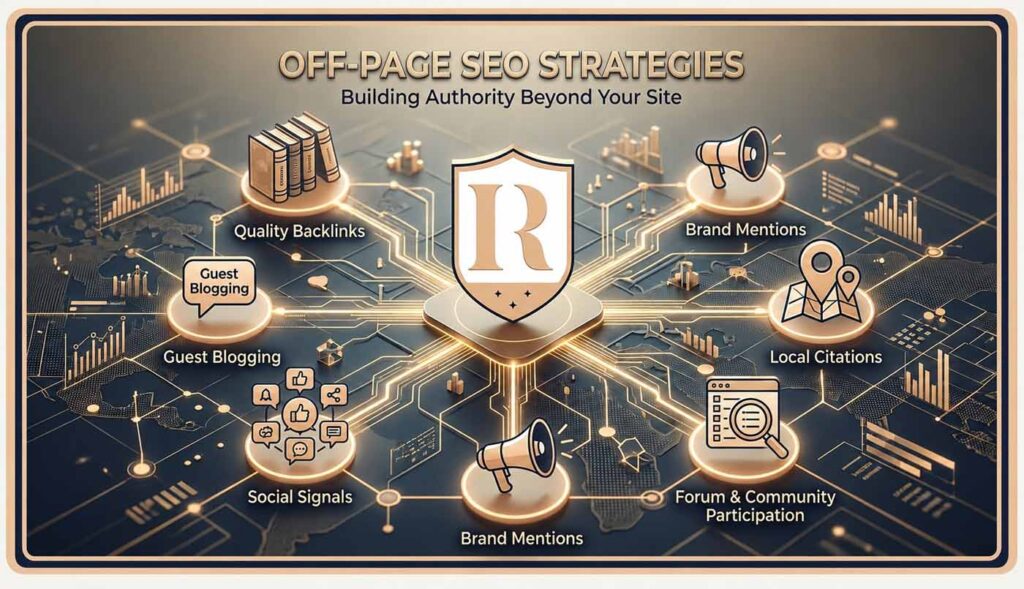
- Guest Posting on Authoritative Blogs: Creating valuable articles for popular websites in your area brings you valuable dofollow links and exposes your business to new audiences.
- Digital PR & Newsjacking: Writing timely stories based on data that are attractive for publication by journalists and bloggers is one of the most scalable types of digital evangelism and link acquisition.
- Broken Link Building: Finding broken links on sites related to your niche and proposing an alternative link to those broken links is a perfectly legal and highly effective link building method.
- Resource Page Link Building: Getting listed on curating resource pages in your niche grants you a dofollow link from a page that actually brings you referral traffic.
- Original Research/Data Studies: Producing original data and statistics naturally draws other writers’ interest and gets your work cited by them, thus creating passive link juice.
The key in every case is relevance and context. A link from a niche blog closely related to your industry is worth far more than a dozen links from unrelated directories. When building links, always prioritise anchor text that reads naturally and accurately describes the linked content, exact-match over-optimisation remains a red flag for Google.
Ready to build a stronger backlink profile?
Brand Citations and Local Business Directories
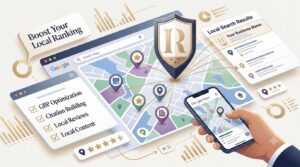
For businesses targeting a particular geographical location, local business citations and directories are very important for achieving offsite SEO success. A citation refers to any mentions made anywhere online about your business using your name, address, and telephone number (NAP), regardless of whether the links are attached or not. These citations include mentions made on directories such as Google Places, Yelp, Bing Places, among others.
Citation is important even if you don’t live in the local area. If your brand name is cited by any reputable website, whether linked or not, Google will interpret it as trust. This is known as an unlinked citation, and it helps build up your E-E-A-T signals. If your business also needs a stronger brand mention, take a look at our dedicated local SEO service.
At a Glance: Offsite SEO Tactics and Their Primary Benefits
| Tactic | Primary Benefit |
| Guest Posting | Earns editorial dofollow links; builds brand authority |
| Digital PR | Mass link acquisition; referral traffic at scale |
| Local Citations | Improves local pack rankings; builds NAP consistency |
| Broken Link Building | White-hat links from relevant resource pages |
| Brand Mentions (Unlinked) | Strengthens E-E-A-T signals; feeds into co-citation |
| Social Media Sharing | Increases content reach; drives referral traffic |
| Influencer Outreach | Authentic brand exposure; niche authority links |
| Forum & Community Engagement | Builds topical authority; earns nofollow links with referral value |
How to Boost E-E-A-T Signals Beyond Your Website
Google’s E-E-A-T framework, which stands for Experience, Expertise, Authoritativeness, and Trustworthiness, has become one of the most discussed concepts in modern SEO. What many site owners miss is that E-E-A-T signals are largely built offsite. Google doesn’t just read your about page; it looks at whether other trusted sources corroborate your expertise.
Some practical measures you can take in order to boost E-E-A-T signals are creating an author profile on reliable websites (LinkedIn, relevant blogs, podcasts), having positive testimonials on Google and Trustpilot, being cited in news articles and interviews, and keeping a consistent brand image on all channels. Together, all these efforts will demonstrate to Google that there are people with authority and experience working for you.
What’s important to remember is that E-E-A-T is particularly essential for YMYL (Your Money, Your Life) niches such as finance, healthcare, law. It means that Google puts extra emphasis on assessing the credibility of sites, and your off-site reputation may be the decisive factor for ranking or being ignored.
Social Media, Referral Traffic, and the Indirect SEO Impact
However, social media does not exchange any link juice equity in the classical meaning because many social sites apply nofollow links. Nonetheless, neglecting the significance of social media as an SEO tool is wrong because the connection between SEO and social networking is more sophisticated. For example, when some piece of content goes viral on LinkedIn, X, Reddit, or other social groups, journalists, bloggers, and site owners have access to that material, thus potentially becoming new link acquisition opportunities for you in the future.
Additionally, besides driving backlinks, social media drives referral traffic, which means that people come to your website from sources other than Google. Although social media indicators do not affect the rankings directly according to Google, high levels of referral traffic and user engagement demonstrate that your pages appeal to people, which will eventually reflect your SEO performance in one way or another. Therefore, a solid content marketing strategy is the most beneficial investment you can make.
Offsite SEO Secrets: Building Authority and Ranking Higher
If, on the other hand, you want to take things one step further, then there’s no shortage of additional topics to cover. Advanced strategies including digital evangelism and link acquisition, analyzing backlinks of competitors, and creating topical authority clusters can matter for helping you rise above your competition. If that’s something that interests you. We’ve put together a wide guide on all those aspects and more, find it all in Offsite SEO Secrets: How to Build Authority and Rank Higher in 2026.
Another often overlooked aspect is optimising your entire web presence, this doesn’t mean only optimizing your main website; it involves social media accounts, business listings, PR mentions, and even affiliates and partners’ websites. Every single aspect of your online identity is relevant when it comes to how search engines build up an image of your brand. Holistic approaches towards offsite SEO strategy are what make the difference between brands ranking well in Google and the rest.
Want to dominate your niche with a full offsite strategy?
Nofollow vs Dofollow: What Really Matters in Your Backlink Profile
In examining your backlink profile, you will come across two basic types of links: dofollow links and nofollow links. In a dofollow link, the authority is passed directly to your website to boost your domain authority. The nofollow link comes with an HTML attribute telling the search engine not to pass any authority to the link, but it does not mean the nofollow link cannot be useful.
A good backlink profile in 2026 should have both of them naturally. Your website having only dofollow links from several sources would seem spammy to Google algorithms. No follow links from well-traveled websites will get you some visits and increase your brand presence and E-E-A-T signals. Just concentrate on getting links that fit in rather than the ratio of dofollow/no-follow.
What a Strong Offsite SEO Programme Looks Like Month by Month
A very frequent error people tend to make is thinking that offsite SEO is something you do just once and be done with it. But in order to get good results, one needs to keep at it. Here is what a typical month-to-month schedule could look like for a company in its growth phase:
- Month 1–2: Audit for backlinks, gap analysis of competitors, and identification of easy citation opportunities.
- Month 3–4: Outreach for guest posts, local citations, and planning for digital PR campaigns.
- Month 5–6: Tracking for variety in anchor text, disavow toxic backlinks, and monitoring of domain authority changes.
- Ongoing: Relationship building with editors, content amplification via social, and regular reporting on referral traffic and keyword improvements.
This kind of structured approach ensures you’re building a backlink profile that grows sustainably rather than spiking and dropping a pattern Google has become very good at identifying and penalising.
Start Building Your Offsite Authority Today
The brands that win in organic search aren’t necessarily the ones with the biggest budgets – they’re the ones that have earned the most trust, both from search engines and from real people across the web. Offsite SEO is how that trust is built, link by link, mention by mention, and citation by citation. With building an organic presence. One of the most strategic decisions you can make for the year 2026 is to work on your offsite SEO strategy. Here at rajatoqier.com, we focus on assisting small and big companies alike to develop an online presence that helps them attract regular organic traffic. Here’s the thing: regardless of whether you require an offsite SEO plan in its entirety or some initial guidance, we’ll be happy to help.