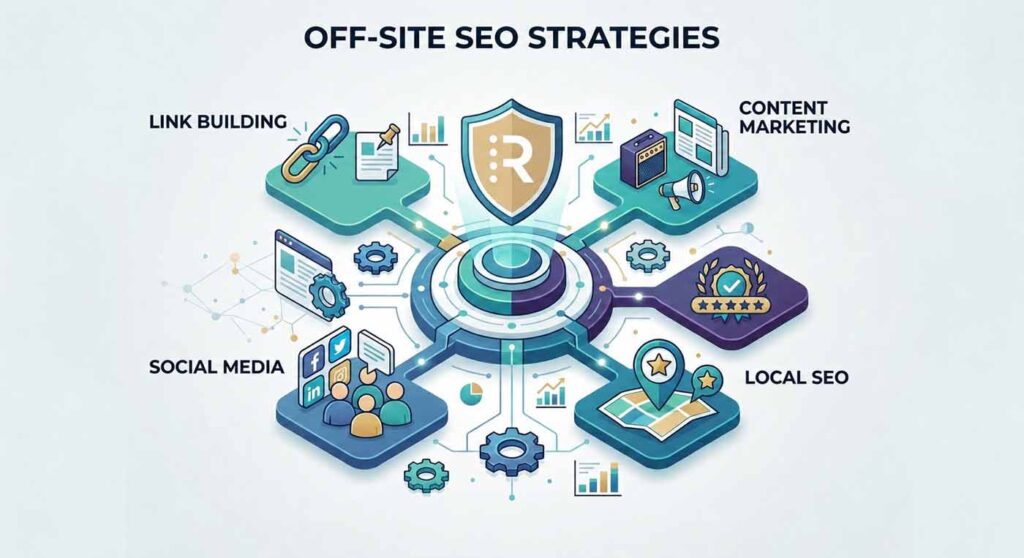
In the ever-evolving landscape of digital marketing, achieving high rankings in search engine results remains a paramount goal for businesses and individuals alike. While optimizing your website’s content and structure (known as on-page SEO) is crucial, it’s only one piece of the puzzle. To truly dominate the search engine results pages (SERPs) and establish your brand as an authoritative voice, you must master the art of off site SEO. This comprehensive guide will unveil the secrets to building unparalleled authority and ranking higher in 2026, exploring strategies that extend beyond your website’s boundaries.
What is Off Site SEO and Why Does it Matter?
Off site SEO, often referred to as off-page SEO, encompasses all the activities performed outside of your website to improve its search engine ranking. Unlike On-Page SEO, which focuses on elements directly within your control on your website, off site SEO is about building your site’s reputation and credibility across the internet. Search engines like Google view these external signals as votes of confidence, indicating that your website is a valuable and trustworthy resource. The more high-quality external endorsements your site receives, the more authoritative it appears, directly influencing its ability to rank for competitive keywords.
In essence, off site SEO demonstrates to search engines that your website is not just well-structured and filled with relevant content, but also recognized and respected by other entities in your industry. This external validation is critical because it mirrors how humans perceive authority and trustworthiness. Without a robust off site SEO strategy, even the most perfectly optimized on-page elements may struggle to achieve top rankings, making it an indispensable component of any successful digital marketing campaign.
The Pillars of Off Site SEO in 2026
To effectively implement off site SEO, it’s essential to understand its core components. These pillars work in synergy to elevate your website’s standing in the eyes of search engines.
1. Backlinks: The Foundation of Authority
At the heart of off site SEO are backlinks, also known as inbound links. These are links from one website to another. Think of them as digital endorsements; when a reputable website links to yours, it signals to search engines that your content is valuable and trustworthy. However, not all backlinks are created equal. The quality of a backlink, determined by the authority and relevance of the linking domain, far outweighs the sheer quantity of links. A single high-quality backlink from an industry leader can be more impactful than dozens of low-quality links from irrelevant or spammy sites.
The process of acquiring these valuable links is known as Link Building. Effective Link Building involves strategic outreach and content creation designed to naturally attract links. This can include creating evergreen content that others want to reference, developing useful tools or resources, or engaging in various outreach tactics. Focusing on White Hat Link Building techniques, which adhere to search engine guidelines, is paramount for sustainable success. These ethical methods ensure long-term benefits and protect your site from penalties. Examples include editorial links (earned naturally through great content), resource page links, and even broken link building, where you find broken links on other sites and suggest your content as a replacement.
2. Domain Authority: Your Website’s Reputation Score
Domain Authority (DA) is a search engine ranking score developed by Moz that predicts how likely a website is to rank in search engine result pages. Ranging from one to 100, with higher scores indicating a greater likelihood of ranking, DA is influenced by numerous factors, most notably the quality and quantity of backlinks pointing to your site. A higher Domain Authority signifies a stronger, more reputable website in the eyes of search engines. Building a strong backlink profile from diverse and authoritative sources is the most effective way to improve your Domain Authority. This, in turn, enhances your website’s overall visibility and ranking potential across a wide range of keywords.
3. Brand Mentions: Beyond the Link
While backlinks are critical, brand mentions also play a significant role in off site SEO. A brand mention occurs whenever your brand name, website, or products are mentioned online, even without a direct hyperlink. Search engines are becoming increasingly sophisticated at understanding entities and their relationships. Unlinked brand mentions, especially from authoritative sources, contribute to your brand’s overall online presence and can be interpreted by search engines as a signal of popularity and relevance. These mentions help build brand recognition and can indirectly influence search rankings by signaling trust and authority, even if a direct link isn’t present. Monitoring these mentions is crucial for understanding your brand’s perception and identifying opportunities for engagement.
4. Social Signals: Engagement and Reach
In today’s interconnected world, social media platforms are powerful amplifiers of content. While social media engagement (likes, shares, comments, mentions) doesn’t directly impact search rankings as a ranking factor, these social signals indirectly contribute to off site SEO by increasing content visibility and driving traffic. When your content is widely shared and discussed on platforms like Facebook, X (formerly Twitter), or LinkedIn, it gains more exposure, leading to more opportunities for backlinks and brand mentions. This increased visibility can also attract the attention of influencers and journalists, further amplifying your reach and authority. A strong Social Media Marketing strategy can therefore be a powerful catalyst for your off site SEO efforts.
5. Digital PR: Earning High-Quality Placements
Digital PR is a strategic approach that combines traditional public relations tactics with digital marketing techniques to earn high-quality backlinks and brand mentions from influential websites, publications, and journalists. It involves creating compelling stories, data-driven reports, or unique campaigns that attract media attention and result in valuable placements. Unlike traditional Link Building, Digital PR often focuses on broader brand visibility and reputation management, with the added benefit of acquiring powerful links. A key tactic within Digital PR is Guest Posting, where you write and publish an article on another website in your industry, typically including a backlink to your own site. This not only provides a valuable backlink but also positions you as an expert in your field, enhancing your E-E-A-T.
6. E-E-A-T: Google’s Guiding Principle
E-E-A-T, which stands for Experience, Expertise, Authoritativeness, and Trustworthiness, is a fundamental concept in Google’s Search Quality Rater Guidelines. It emphasizes the importance of demonstrating genuine experience, deep knowledge, established authority, and unwavering trustworthiness to both users and search engines. Every aspect of off site SEO contributes to building your E-E-A-T. High-quality backlinks from reputable sources validate your authority, while positive brand mentions and Digital PR efforts reinforce your trustworthiness and expertise. By consistently producing valuable content and earning endorsements from credible sources, you signal to Google that your website is a reliable and authoritative source of information, which is increasingly vital for ranking success in 2026.
Key Strategies for Off Site SEO Success in 2026
Implementing a successful off site SEO strategy requires a multifaceted approach, focusing on quality, diversity, and continuous improvement.
Diversifying Your Link Profile
While acquiring powerful backlinks is crucial, it’s equally important to diversify your link profile. This means obtaining links from a variety of sources, including industry blogs, news sites, educational institutions, and relevant directories. An unnatural or overly uniform link profile can raise red flags with search engines. Aim for a mix of dofollow and nofollow links, and ensure that the anchor text used for these links is natural and varied, avoiding over-optimization. A diverse link profile signals a more organic and authentic growth of your website’s authority.
Strategic Anchor Text Usage
Anchor Text is the visible, clickable text in a hyperlink. It plays a vital role in conveying to search engines what the linked page is about. While it’s tempting to use exact-match keywords for every link, this can appear manipulative and lead to penalties. Instead, focus on natural and diverse Anchor Text usage. This includes branded anchor text (your brand name), naked URLs, generic phrases (e.g.,
“click here”), and partial-match keywords. The goal is to make the anchor text look natural and helpful to users, rather than solely optimized for search engines. This diversity helps avoid over-optimization penalties and contributes to a healthier link profile.
Monitoring and Analysis
Effective off site SEO is an ongoing process that requires continuous monitoring and analysis. Regularly tracking your backlinks, Domain Authority, and brand mentions is essential to understand the impact of your efforts and identify areas for improvement. Tools like Semrush, Ahrefs, and Moz can help you monitor your backlink profile, analyze competitor strategies, and identify new link opportunities. Furthermore, conducting a regular SEO Audit can help you identify any toxic backlinks that might be harming your site and take corrective action. Setting up Google Analysis Setup will provide insights into traffic sources and user behavior, helping you refine your overall SEO strategy.
Common Off Site SEO Mistakes to Avoid
While the potential rewards of a strong off site SEO strategy are significant, it’s crucial to avoid common pitfalls that can harm your website’s ranking and reputation.
One of the most critical mistakes is engaging in Black Hat SEO tactics. These are unethical and manipulative practices designed to trick search engines into ranking a site higher. Examples include buying links, participating in link schemes, or using hidden text. While these tactics might offer short-term gains, they inevitably lead to severe penalties from search engines, resulting in a significant drop in rankings or even complete de-indexing. Always prioritize White Hat Link Building techniques for sustainable and ethical growth.
Another common error is focusing solely on the quantity of backlinks rather than their quality. A large number of low-quality, irrelevant, or spammy links can be detrimental to your site’s authority. Search engines are sophisticated enough to distinguish between valuable and manipulative links. Therefore, always prioritize acquiring links from authoritative, relevant, and trustworthy websites, even if it means a slower pace of link acquisition. Quality over quantity is a golden rule in off site SEO.
Conclusion
Mastering off site SEO is no longer an option but a necessity for any website aiming to achieve and maintain high search engine rankings in 2026. By strategically building high-quality backlinks, cultivating a strong Domain Authority, fostering positive brand mentions, leveraging social signals, and engaging in effective Digital PR, you can significantly enhance your website’s authority and trustworthiness in the eyes of search engines. The principles of E-E-A-T should guide every aspect of your off site SEO efforts, ensuring that your strategies are aligned with Google’s evolving guidelines for quality and relevance.
Remember, off site SEO is a marathon, not a sprint. It requires consistent effort, strategic planning, and a commitment to ethical practices. The rewards, however, are substantial: increased organic traffic, higher search rankings, and a stronger, more reputable online presence. For further insights into off-page SEO strategies, you can refer to this comprehensive guide from Semrush Blog on Off-Page SEO.Ready to elevate your website’s authority and dominate search results? Explore our Off-Page SEO services today and let us help you implement these powerful strategies for 2026. Contact us for a consultation!