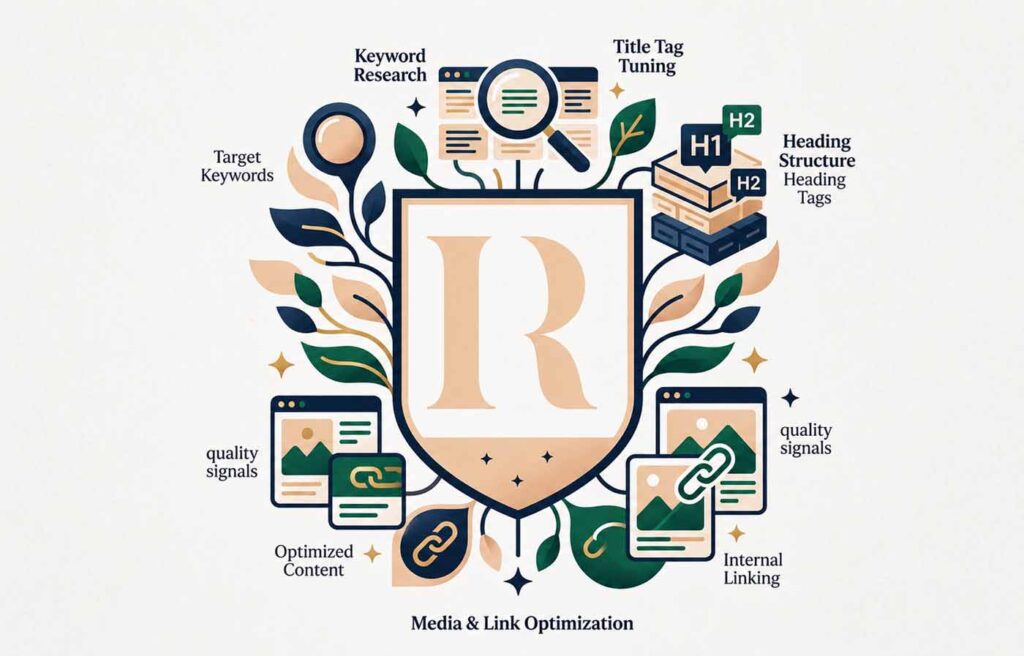
What Is On-Page SEO Content and Why Does It Matter So Much?
If you’ve been putting out blog posts and pages without seeing much movement in search rankings, the issue is very likely on page SEO content. It’s one of those things that sounds straightforward: optimize your pages, use the right keywords, done, but the reality is a lot more nuanced. Done well, it can move you from page 3 to page 1. Done poorly, even excellent writing gets buried.
On-page SEO refers to all activities that can be done right from a website in order to boost its rankings on search engine results pages. It is basically related to the way the content is written, the keywords used, and how easily a site can be read by both humans and robots. If you’re managing this in WordPress specifically, our beginner’s guide to on-page SEO in WordPress covers the plugin setup and checklist step by step. On-page SEO is concerned more with developing sites that meet the genuine needs of the users.
For more insight into how on-page SEO really works, one can visit the experts at Raja Toqier, who offer a wide array of SEO services for real traffic, not just better rankings.
Ensure You Have Proper Title Tags and Meta Descriptions
The harsh reality is that most users will scan past your title and won’t even click through. If your title tag isn’t conveying any form of value or relevancy to a user from the very beginning, you lose the click, regardless of the quality of the information provided within the article. Ideally, your title tag would start with your target keyword if applicable and be less than 60 characters long.
Although your meta description doesn’t impact rankings, it does affect click-through rate. And click-through rate, in turn, impacts how Google evaluates the relevance of your page to its users. Your meta description is like a short pitch for your article, a way of telling the user in one quick sentence what value your content can provide. Keep it under 155 characters and write it for humans first.
Optimizing title tags for click-through rate is an art form. Numbered points, brackets, power words, and questions work great, but what really counts is whether or not the title reflects the intent that goes along with the search query. You have to make sure that if someone does a search for ‘how to fix slow website speed’ and the title of your blog post is ‘Page Speed Tips,’ then it’s wrong. Make sure your title reflects the intent of the search query and watch your CTR increase.
How to Structure Your Blog Post Using Header Tags (H1-H6)
Search engines determine the structure of your content from the use of header tags (H1-H6). You have to use a header tag once per page, and it should contain your primary keyword. These are the section headings in your blog posts. H3s and below are for sub-points within those sections.
However, the benefits of using good header hierarchy aren’t limited to the crawlers; they extend to users as well. When someone lands on your page, they scan before they read. It provides them with navigation signs saying “this is what is covered in this part” and “how everything in this section fits together,” thus increasing dwell time and decreasing bounce rate while informing Google that the page contains valuable content.
Don’t overload all your headers with keywords. Use them only when appropriate and when they would occur naturally in any conversation. Forced keyword placement makes content feel robotic, and search engines have gotten quite good at detecting it.
The On-Page SEO Factors That Actually Move the Needle
Enough with all the chatter. You can find a plethora of on-page factors that should be considered. However, there are some that matter much more than others. Below is a practical table of reference outlining all relevant components, their importance and action items:
| SEO Factor | Importance | Quick Tip |
| Title Tag | Critical | Include primary keyword near the beginning |
| Meta Description | High | Write for clicks, include keywords naturally |
| H1 / Header Tags | Critical | One H1 per page; use H2-H4 for structure |
| Keyword Placement | High | First 100 words, headers, and naturally throughout |
| Internal Linking | High | Link to related pages to pass authority |
| Image Alt Text | Medium | Describe image + include keyword where relevant |
| URL Structure | High | Short, descriptive, keyword-rich URLs |
| Page Speed | Critical | Aim for under 3 seconds load time |
| E-E-A-T Signals | Very High | Show expertise, author bios, trust signals |
| Schema Markup | Medium | Add structured data for rich snippets |
This will give you a full blueprint for ranking better in 2026, from the technical basis to content strategies.
Keyword Placement in Body Copy – Natural, Not Mechanical
It seems to be widely believed in the SEO world that having the right percentage of keyword density is crucial to being rewarded by Google’s algorithm. Unfortunately, things have changed and current algorithms rely on semantics. Instead of focusing on how many times you repeated ‘best running shoes,’ they consider the comprehensiveness of your page regarding the subject matter.
However, there are certain locations where keywords play their part in the success of a website. The most important ones are the following:
- First 100 words: Getting your primary keyword in early tells both readers and search engines what the page is about
- Subheadings: Place primary and secondary keywords naturally without forcing them into the writing
- Image alt text: A great chance to incorporate keywords and improve accessibility at the same time
- Anchor text: Your link text should accurately reflect the target page and be keyword-rich
- URL slug: Short, clean, keyword-included, avoid dates or stop words
- Conclusion: Highlight the topic of your content one final time naturally
Content optimization goes beyond just the location of the keywords. It is important to do semantic content optimization that talks about sub-topics relevant to your main subject matter. This is what builds topical authority, which is increasingly how Google decides who deserves the top spots.
Internal Linking: The Underestimated SEO Technique Almost Every Site Gets Right
There’s a single SEO strategy that’s continually underestimated, and that’s internal linking. Most site owners add a few footer links and call it done. But internal links do several important things: they help search engines discover and crawl your content, they pass link equity (authority) between pages, and they keep visitors on your site longer by guiding them toward related content.
A good internal linking strategy connects thematically related pages. When discussing on-page SEO, it’s only logical to include a link back to your technical SEO services page, SEO audit services page, or even blog post about local SEO because anyone reading about those terms may be interested in learning more about the other topics as well.
The anchor text you use for internal links matters as well. Anchor texts that include descriptive keywords can help search engines better identify the content of the page linked to. It would be pointless to use phrases such as ‘click here’ or ‘read more’. For a comprehensive resource on off-page factors that work alongside your on-page efforts, the off-page SEO service covers link building and authority-building strategies in detail.
For a comprehensive resource on off-page factors that work alongside your on-page efforts, the off-page SEO service covers link building and authority-building strategies in detail.
E-E-A-T Content Requirements: How Google Judges Trust & Quality
In recent years, Google has placed increasing emphasis on E-E-A-T- Experience, Expertise, Authoritativeness, and Trustworthiness. While these don’t directly influence rankings per se, they certainly have an effect on how Google’s quality raters rate web pages, which is how they ultimately train the algorithm.
Practically, this means your content needs to demonstrate that it was written by someone who knows what they’re talking about. That could mean including an author bio with credentials. Citing reputable sources, showing real-world examples or case studies, keeping your content regularly updated, and making it crystal clear who is behind the website.
When dealing with industries like healthcare. Banking, or even legal services (Google refers to these as YMYL categories), signals related to expertise, experience, authoritativeness, and trustworthiness are especially important. Still, they’re just as important for more mundane service companies too. Here’s the thing: reviews, testimonials, case studies, About pages, and contact information all contribute to the credibility of your site in Google’s eyes.
For industries like health, finance, or legal services, what Google calls YMYL (Your Money or Your Life) topics, E-E-A-T signals are especially critical. But even for everyday service businesses, trust signals matter. Reviews, testimonials, case studies, About pages, and contact information all contribute to the overall credibility of your site in Google’s eyes.
One fantastic resource related to the technical aspects of on-page factors is this comprehensive SEO guide by Mangools.
URL Structuring and Image Alt Text: Small Details, Big Impact
Creating URL structuring can either be a walk in the park when done from the beginning or an extremely difficult task when done late in the game. An ideal URL should be brief (less than 60 characters), contain your main keyword, have hyphens between the words, and lack excessive folder names, dates, or numbers. Here’s an example comparison of two URLs.
- yoursite.com/blog/2024/04/28/how-to-do-seo-content-optimization/?id=1092
- yoursite.com/on-page-seo-content-optimization
The second URL is obviously shorter and more meaningful. If you’re doing a site migration or URL restructuring, make sure you set up proper 301 redirects or consider using a website migration SEO service to handle it without losing your existing rankings.
Image alt tags are another SEO component that is frequently neglected. The image on your website should always have some form of description written in its alt attribute. This is necessary both because it enables visually impaired individuals to understand what is being shown in the image (an increasingly popular criterion in many locations) and provides more information to the crawler about the topic of your site.
Creating an SEO Content Writing Strategy That Is Scalable
Individual well-optimized pages are valuable, but real organic growth comes from a scalable SEO content writing strategy. This requires moving beyond singular articles to creating a network of content around specific themes. The concept of topic clustering often includes:
- Pillar page: An in-depth page written on the general theme (such as a service-specific on-page SEO page)
- Cluster content: Specific blog posts about smaller themes that link back to the pillar
- Consistent internal linking: Every cluster piece connects to the pillar and to other relevant cluster pieces
- Regularly updated content: Keeping the pages refreshed with new facts, figures, or other data helps keep them fresh and up-to-date.
This model builds topical authority – the sense that your site is the definitive resource on a given subject. Topical authority is increasingly what separates sites that rank consistently from those that appear occasionally and then disappear. It also creates a multiplier effect as more and more cluster content gains traction, raising the whole cluster along the way.
Combine this with a good user experience and content readability that actually make people want to read them. These pages send good signals to Google, which makes sure you keep your ranking in the long run.
E-Commerce On-Page SEO: The Rules Change Here
If you run an e-commerce store, on-page SEO for e-commerce brands requires a slightly different approach. This is more than optimizing blog posts; it includes optimizing product pages, category pages, and collections pages, each with its own set of difficulties.
Product pages require unique descriptions, keyword-rich titles, schema markup for ratings and pricing, and a useful call to action. Category pages tend to perform better if they have some introduction explaining what the category entails, a list of products without any written content is not ideal.
E-commerce sites also tend to have duplicate content issues (multiple URLs for the same product with different filters or sorting), which need to be handled with canonical tags. The use of schema markup and structured data is especially important in e-commerce because it allows for rich snippets to appear in search engine results pages that provide rating, pricing information, and whether the products are in stock.
Ready to Drive Real Organic Traffic? Let’s Build Your On-Page SEO Strategy
Creating useful on-page SEO content isn’t a one-time task, it’s an ongoing discipline that compounds over time. Every page you optimize, every internal link you build, every title tag you sharpen adds up to stronger search visibility and more consistent organic traffic. Those brands that always appear in the search engines are not lucky; they have done the groundwork and made sure everything is in place, page by page.It does not matter whether you are building something from scratch, or recovering from a lost position; you need to know the tricks of the trade in order to accomplish your objective. If you are ready to change things for the better, contact Raja Tqier’s team.