Why Most Businesses Are Invisible in Local Search (And How to Fix It)
If you’ve ever Googled a restaurant, plumber, or hair salon near you, you already understand how local SEO services work – even if you’ve never heard the term. These are the strategies that decide which businesses show up when people search “near me” or in your city, and which ones stay buried on page three where nobody looks. The frustrating truth is that most small businesses are completely invisible in local search, not because they’re bad at what they do, but because nobody ever told them how to get found.
Think about it: when someone nearby is looking for exactly what you offer, they turn to Google. They’ll click the top three results – maybe four – and never scroll further. That little cluster of map results you see at the top? That’s called the Local Pack, and landing there can transform a slow week into a fully booked one. Getting there takes more than just creating a website and hoping for the best.
If your business isn’t showing up where your customers are searching, that’s not just a missed opportunity – that’s revenue walking straight into a competitor’s door. The good news is that this is entirely fixable with the right approach.
The Foundation: Optimising Your Google Business Profile
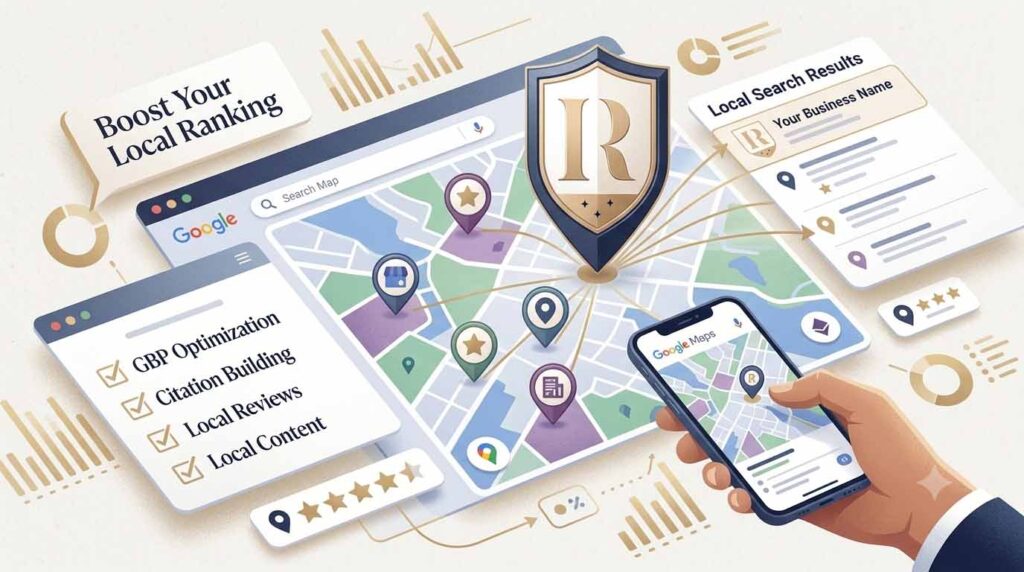
Local Search starts with your Google Business Profile (formerly Google My Business). This free listing is your most powerful tool for appearing in Map Pack Rankings and local organic results. Yet you’d be amazed how many businesses either haven’t claimed theirs or have left it half-finished with outdated information.
Optimising your profile is about more than just adding your address and phone number. You want new, interesting photos, a business description with keywords, correct categories, and service areas set up properly. Google rewards profiles that are full, active and engaging. To get the full scoop on how to do this well, check out this complete guide to optimising Google My Business for 2026 – it takes you from the very first setup step all the way to advanced tactics for ranking higher.
A few things that make a difference: post regularly to your profile, answer Q&A proactively, and keep your hours accurate, especially around holidays. These little signals tell Google that your business is alive and trustworthy.
Get Your Google Business Profile Optimized
NAP Consistency: The Silent Ranking Factor
Here’s one that trips up a lot of businesses: NAP Consistency, which stands for Name, Address, and Phone Number. Your NAP information needs to be identical – not just similar – everywhere it appears online. Your website, Google Business Profile, Facebook page, Yelp, local directories, all need to be in perfect sync.
Why is this so important? Google cross-checks your business information on the web to make sure you’re a real, established business. If your address says “Suite 200” in one place and “Ste. 200” in another, or your phone number varies slightly anywhere, Google gets confused – and that confusion hurts your rankings.
Start by auditing every mention of your business online. Fix inconsistencies in local citations/listings on directories such as Yelp, Yellow Pages, Bing Places, Apple Maps and speciality directories. Local Directory Submissions in high-authority directories also act as trust signals that boost your credibility in the eyes of Google.
Key Local SEO Ranking Factors at a Glance
| Ranking Factor | Impact Level | What to Focus On |
| Google Business Profile | Very High | Complete profile, regular posts, photos |
| NAP Consistency | High | Identical info across all directories |
| Customer Reviews | Very High | Volume, recency, and responses |
| Local Citations | High | Quality directories, accurate listings |
| On-Page Local SEO | High | Location keywords, schema markup |
| Backlinks from Local Sites | Medium-High | Local news, blogs, sponsors |
| Proximity | Very High | Distance from searcher (partly uncontrollable) |
On-Page SEO: Talking Your Website’s Local Language
You need to be clear on your website itself where you are and what you do. That’s where Geographic Keyword Targeting comes in naturally, including your city, neighbourhood and service area names in your page titles, headings, meta descriptions, and content. Not filling them all clumsily, but writing the way that a local would really talk.
Say you have a generic page called “Plumbing Services” but you want to change it to “Emergency Plumber in Austin, TX.” That change in specificity is the difference between being able to rank locally and not being able to rank at all. A solid On-page SEO strategy ensures that each page on your website is doing its job for local visibility.
Technical elements are massively important beyond keywords. Adding Schema Markup and LocalBusiness schema gives Google structured data about your location, hours, and services. This is especially critical for Near Me Search Queries where Google needs to quickly validate your relevance. Your Structured & Schema Markup: The way you implement your data can be the difference between a rich snippet and a plain blue link.
Why Customer Reviews Are Important For Local Search
If there’s one thing that affects both organic search rankings AND customer decisions at the same time, it’s reviews. Customer reviews are a direct ranking signal for Google’s local algorithm; the more you have, the more recent they are, and the higher your average rating, the better your chances to appear in the Local Pack.
But there’s one layer that most businesses miss, and that’s responding to reviews. Google can tell when you interact with feedback, whether it’s good or bad. It lets the other person know that you are active and responsive. And for potential customers reading those reviews, thoughtful responses build trust faster than any marketing copy can.
A good online reputation management strategy includes a review-generation system in the customer journey. Ask for reviews from happy customers immediately after service, make it easy with a link directly to your Google review page, and follow up with a friendly reminder email. This isn’t gaming reviews, this is about removing the friction that keeps happy customers from sharing their experience.
Ranking in Multiple Locations Without Confusing Google
One issue that many businesses face relates to ranking in different cities or even different neighbourhoods. It involves how to make use of the same content to rank highly for two or more locations while avoiding duplication, which will inevitably thin down the content. This is perhaps one of the most frequent issues discussed about local SEO services for small businesses, and when it is done incorrectly, it will end up harming their performance in all locations.
The right thing to do is to make separate and useful pages for each and every location that you cater to. Your pages must be distinct and unique, rather than simply adding another city into the page content. There is a good guide from the community of Moz about how to optimize your site for several cities.
The use of a Localized Content Strategy is useful in such cases too. You can write blog posts that talk about local events, activities, or issues, which will help you to use geotargeting signals. This hyperlocal digital marketing will create authority for you in your own locality.
Start Ranking in Your Target Locations
Local Backlinks That Really Matter
Not all kinds of backlinks are equally effective when it comes to local SEO. Having a backlink from a national website may help, but how about having a backlink from the local newspaper or the Chamber of Commerce in the city? That’s gold. These local links send a powerful geographic relevance signal that broad links simply can’t replicate.
Practical ways to build local links include sponsoring community events, partnering with complementary local businesses, getting featured in local press, and joining local business associations. An Off-Page SEO strategy built around local authority is fundamentally different from generic link-building – and far more effective for dominating your geographic area.
Technical SEO: The Unseen Motor Driving Local SEO Success
No matter how much time you spend developing content strategies, none of it will matter if you don’t have a technically optimized website that loads fast and is secure and easy to crawl. Technical SEO factors, including loading speed, mobile compatibility, security, and site structure, are crucial.
Mobile performance is especially critical for local search. Most near me search queries happen on smartphones, often when someone is already out and looking for something immediately. If your site takes five seconds to load or is hard to navigate on a phone, you’ve already lost that customer – even if you ranked number one.
Key technical building blocks for success in local SEO:
- A mobile-first site design that is fast to load on all devices
- An HTTPS SSL security certificate (which Google uses in its ranking algorithm)
- Web Vitals performance scores in the “Good” category on all metrics
- An XML sitemap added to Google Search Console
- URLs with good structure, including geographic keywords if appropriate
- Schema.org/localBusiness markup used appropriately
What Makes Good Local SEO Distinctive vs. Extraordinary Success
What sets the businesses apart from each other that manage to have some visibility versus those that rule the roost is not any individual action; rather, it’s how everything works together. Your Google Business Profile optimization impacts your reviews. Your NAP consistency strengthens your citation signals. Your on-page geotargeting reinforces your location pages. Your local backlinks amplify everything else.
It’s also about consistency over time. Local SEO is not a one-off task but a process. Businesses that maintain their profiles, keep earning fresh reviews, update their content seasonally, and monitor their rankings are the ones who stay at the top once they get there.
At Raja Tqier, we work with businesses that are tired of being invisible and ready to own their local market. Whether it comes to building your Local SEO from scratch or making improvements where necessary, this is something that is based on the reality of how things really work – no tricks involved.
Ready to Dominate Your Local Market? Let’s Talk
If you’ve read this far, you already know more about local SEO than most of your competitors. Now it’s time to put that knowledge to work. Whether you’re a restaurant trying to fill tables, a service business chasing more calls, or a retail shop wanting more foot traffic, a well-executed local SEO services strategy can make it happen – and the results are measurable, trackable, and real.
The best time to start was six months ago. The second best time is today. If you’re ready to stop leaving local customers to your competitors, contact us and let’s build a plan that gets your business in front of the people in your area who are already searching for what you offer.