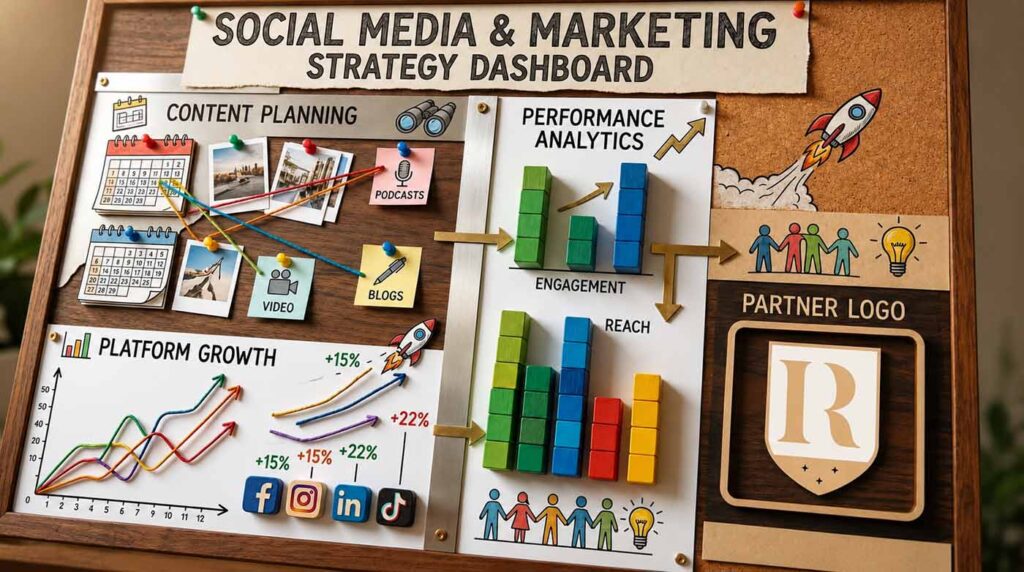
Key Takeaways:
Social media and marketing work as one system: Social platforms provide the reach, while marketing strategy determines who you target, what you post, and how you measure results.
Focus beats coverage: Brands that dominate 2–3 platforms suited to their audience consistently outperform those spread thin across every channel.
Social media supports SEO indirectly: It’s not a direct ranking factor, but shared content earns backlinks, drives branded search, and boosts referral traffic.
Social listening turns data into strategy: Tracking brand mentions, sentiment, and trends helps marketers shift from reactive posting to proactive, customer-led content planning.
ROI comes from the right metrics: Conversion rate, cost per lead, and customer lifetime value matter more than vanity metrics like likes and follower count.
What Is Social Media Marketing and Why Does It Matter for Your Business?
Are you curious about how companies build brands quickly and convert followers into paying customers? The key to this will definitely be in the synergy between social media and marketing. Here’s the thing: such interaction creates brand visibility, generates traffic, and builds the level of trust that leads to conversions. So, social media will be your broadcasting platform, while marketing will bring the strategic meaning behind each post you publish.
How Social Media and Digital Marketing Work Together
Consider the digital marketing strategy as an engine, and social media as fuel. Neither works optimally alone. Your marketing strategy defines your target audience, what content to create, when and how to post it, and how to track performance. The advent of platforms such as Instagram, LinkedIn, Facebook, and TikTok has revolutionized the way brands connect with consumers. According to DataReportal more than 5 billion people are currently active users of social media platforms all around the world, and the brands that are visible, consistent, and authentic through their social media presence are the successful ones.
Curious about what social media marketing can achieve for your brand? Explore our dedicated service page for a deeper look.
Add in quote
Not Sure Where to Start?
Get a tailored social media and marketing strategy built around your audience, platforms, and goals.
How Do You Build a Social Media Marketing Strategy That Actually Drives Conversions?
A social media marketing strategy that produces conversions is one that’s built on solid data, target audience insights, and intelligent content planning.
Step-by-Step: Build a Strategy That Converts
- Set your goals: awareness, leads, sales, or retention.
- Discover your target customers through demographics and psychographics.
- Select appropriate channels: LinkedIn for B2B and Instagram/TikTok for B2C visual brands.
- Make a content calendar for posting and running stories, reels, and campaigns.
- Create quality content that either provides information, amuses, or solves an actual problem.
- Use marketing analytics tools such as Meta Business Suite, LinkedIn Analytics, or any third-party dashboards.
- Analyze results, iterate, and promote the most successful initiatives.
It would be useful to learn how social media marketing plays into SEO. Even though social shares aren’t ranking factors themselves, viral content receives backlinks and branded searches. Learn how we approach social-driven SEO strategy at rajatoqier.com.
Which Social Media Platforms Should You Focus on for Maximum ROI?
Not every platform deserves equal attention. The best channel is where your ideal customer already spends time and where your content format naturally fits. Spreading yourself too thin leads to average results everywhere. Instead, dominate 2-3 platforms with focused, high-quality content.
Platform-by-Platform Guide for Business Owners
| Platform | Best For | Content Type | Avg. Engagement |
| B2B, Professional Services | Articles, Thought Leadership, Case Studies | Medium–High | |
| B2C, E-commerce, Lifestyle | Reels, Stories, Carousels | High | |
| TikTok | Youth Brands, Viral Content | Short-form Video | Very High |
| Local Business, Community | Groups, Ads, Events, Live Video | Medium | |
| E-commerce, Home, Fashion, Food | Visual Pins, Idea Boards | Medium–High |
Staying current with platform algorithm changes is essential. An excellent resource for this is LinkedIn post by Morgan C, a useful snapshot of what marketers need to be watching right now.
How Does Social Media Marketing Connect to SEO and Organic Growth?
One of the most underrated aspects of social media and marketing is how directly it supports your long-term search engine optimization (SEO) performance. When your content gets shared at scale, it earns natural backlinks. When people discover your brand on social and search for it on Google, your branded search volume rises – a strong quality signal for search engines.
Practical Ways Social Media Supports Your SEO Strategy
- Content shared widely on social platforms attracts editorial backlinks, one of the strongest SEO ranking signals.
- Increased brand visibility on social drives branded searches, boosting domain authority signals.
- Social profiles (especially on LinkedIn and YouTube) can appear in Google search results based on branded search terms.
- Reposting content from your blog on your social media channels increases visibility and referral traffic to your website.
- User-generated content, reviews, and comments boost your credibility, which falls under the guidelines of Google’s E-E-A-T model.
If you take organic growth seriously, social media marketing and SEO need to be considered two sides of the same coin. Take a look at our SEO service page to learn more about it.
What Is Social Listening and Why Should Marketers Use It?
Social listening entails analyzing mentions of your brand, competitive activity, industry trends, and customer sentiment on social media in real-time. Social listening happens to be one of the most important yet underutilized tools that marketers have at their disposal.
How to Use Social Listening to Improve Your Digital Marketing Strategy
- Listen to mentions of your brand to gain insights into perceptions of your brand.
- Analyze competitor activity to identify weaknesses and capitalize on them.
- Detect trending subjects to produce engaging and timely content.
- Analyze customer sentiment to boost CRM and take proactive action on potential problems.
- Structure your content calendar based on your customers’ interests, not yours.
Used correctly, social listening serves as the link between your data and customer engagement. This is what helps you evolve from reactive to proactive marketing that puts the interests of your clients first.
How Do You Measure Social Media Engagement and Prove ROI?
One of the difficulties that most business owners experience when trying to prove the efficiency of their social media efforts is figuring out the right metrics that measure performance and learning how to tell vanity metrics from business ones.
The Metrics That Actually Matter for Social Media ROI
- Conversion Rate: the share of your visitors that convert into something you want them to (subscribe, buy, make an appointment).
- Cost per lead (CPL): total ad spend divided by total leads generated from social campaigns.
- Customer Lifetime Value (LTV): to maximize customer lifetime value (LTV), track how customers acquired via social media compare over time.
- Engagement rate: likes, comments, shares, and saves relative to reach a quality signal that algorithms reward.
- Traffic from social: use GA4 to track backend data for sustainable growth and understand how social channels contribute to overall website conversions.
The brands that consistently win are those that measure social media engagement and conversion rates obsessively and use those insights to improve every future campaign. If you want to understand how to build data-driven email and SMS infrastructures alongside your social strategy, our content marketing service is built for exactly that.
How Are AI and Emerging Technologies Changing Social Media Marketing?
The marketing landscape is evolving faster than ever. AI-driven search is reshaping how users find content, and the rise of Google AI Overviews is already reshaping how brands attract organic traffic and forcing a rethink of content strategy. Generative AI tools are also transforming how marketers create, test, and streamline marketing with advanced AI tools at scale.
What Smart Marketers Are Doing Right Now
- Using AI to optimize social media content calendars, automatically scheduling posts for peak engagement windows.
- Using AI analytics to transform social media followers into captured leads via personalized funnels.
- Staying on top of changes by following top digital marketing blogs.
- Improving marketing operations by using AI to perform A/B tests of advertising creative, creating captions, and tracking competitors.
- Creating omnichannel strategies involving social media, SEO, emails, and SMS to increase the LTV of customers.
It’s the brands that consider social media a separate channel that are left behind in this fast-moving world. Read our guide on turning social media followers into paying customers for practical strategies for small business owners ready to level up.
Ready to Build a Brand That Actually Converts?
Social media and marketing done right isn’t about going viral; it’s about building a system. This is a system for increasing your brand awareness. Developing your audience engagement generates leads and turns them into loyal clients at each step along the way. Whether you’re just getting started or looking to improve your current online presence, these steps will provide you with the guidance you need. Here’s the thing: if you’re done guessing and ready to grow, contact us; we’ll be glad to work with you.
Frequently Asked Questions
Social media marketing is the practice of using platforms like Instagram, LinkedIn, Facebook, and TikTok to build brand visibility, engage audiences, and drive measurable business results. First of all, you’ve to identify your target audience, select the appropriate platforms, prepare your content calendar, and measure key performance indicators such as reach and engagement.
A successful digital marketing campaign begins with setting business objectives, which can include branding, lead generation, or sales. Conduct market research, channel audit, theme planning, regular posts, and marketing analysis.
Your choice of platform will be defined by the nature of your target audience and your industry niche. LinkedIn will work for B2B brands, while Instagram and TikTok will suit more visual consumer-based brands. Here’s the thing: Facebook is good for community engagement and local businesses. Instead of covering everything, choose only 2-3 platforms where you’ll interact with your target customers actively.
Social media platforms have no impact on your SEO ranking, but they help to optimize your site’s SEO indirectly. Your widely shared content will earn backlinks, will make branded searches, and will increase referral traffic, all of which Google appreciates. Here’s the thing: besides, active social media pages will pop up in branded search results.
Social Listening is an activity through which businesses can monitor social media networks for references to their brands. Competitor brands, products, or the industry as a whole. This activity can help gain immediate insights into customer behavior, trends, reputation management, and digital marketing strategies.